DeepSpaceNine DeepSpaceNine

Q+A regarding Star Control and Paul and Fred

Q+A regarding Star Control and Paul and Fred

Given the ongoing discussion of the legal dispute between Stardock and Paul Reiche and Fred Ford, designers of Star Control I and II, I wanted to take time to make Stardock's position clear and address inaccuracies that have been promoted.

As the need arises, I’ll continue to update this post with additional questions and answers.

Q: What are the issues in dispute?

A: On the eve of launch of the beta of Star Control: Origins in October 2017, a game Stardock has spent the past four years working on, Paul Reiche III and Fred Ford, the designers of Star Control II for Accolade 25 years ago announced a new game, Ghosts of the Precursors as a “direct” sequel to Star Control even going so far as to promote it as Star Control: Ghosts of the Precursors.

They did this despite knowing Stardock had acquired the Star Control IP in 2013 and knowing before hand our announcement schedule. Their actions created confusion in the market as to the origin of Star Control games which is why we have trademark laws. 

When Stardock asked that they cease and desist marketing their game as a sequel to Star Control they refused and began demanding that the sale of the DOS games, which had been on sale continuously since before Stardock acquired the IP and for which they had been receiving royalties for during the entire time cease and began to disparage Stardock publicly in the press. 

Despite Stardock's best efforts to reach a private, mutually beneficial co-existence agreement, Paul and Fred responded with increasingly hostile, misleading public attacks and served Steam and GOG with DMCA take-down notices on all of the classic DOS games, including Star Control 3 which they had no involvement with all while continuing to promote their new game as the "true" sequel to Star Control.

In addition, Paul Reiche and Fred Ford also began to claim that various features of Star Control: Origins violated their copyrights such as the ship designer, user interface similarities and other elements that are not subject to copyright protection (you can’t copyright an idea and Star Control itself was inspired by many other games). They also began to demand special access to Star Control: Origins to inspect it and demanded the removal of the ship designer,

As a result of their broad interpretation of what they believe they have rights to combined with their willingness to instruct their lawyers to issue a DMCA take down notices, even on titles in which they had no involvement in, combined with their refusal to cease promoting their game as the sequel to Star Control, Stardock was forced to file a complaint over their continuing trademark infringement.

In retaliation, Reiche and Ford filed a countersuit seeking to cancel the Star Control trademark and for copyright infringement due to the sale of the classic Star Control games on GOG and Steam and are even suing GOG despite the fact that Reiche and Ford were the ones who claim to have helped get the classic Star Control games onto GOG.

Q: Why did Stardock file the initial lawsuit against Paul and Fred?

A: We had no choice after Paul and Fred filed DMCA claims against the distribution not only of Star Control 1 and 2 but also Star Control 3 which they admit they had no involvement.  The DMCA claims were reversed, but it was clear that our ability to create more experiences in the Star Control multiverse for fans would be at risk if they are allowed to continue to misrepresent their new game as being associated with Star Control without a license while simultaneously making broad, unsupportable claims of ownership on ideas and concepts that are present not just in Star Control games but games in general.  

Q: How did these unfortunate events come to pass?

A: Here is a timeline of the order of events:

  1. Stardock acquires the Star Control brand, copyright to Star Control 3, the license to use the Star Control classic characters, lore and the right to distribute the classic DOS games.  The DOS games are already available on GOG  with Atari listed as the publisher. (2013)
  2. Stardock discuss plans for the new Star Control.  They state that their employment by Activision prevents them from working on a new Star Coxntrol game and request that we not use the aliens from Star Control 2 but do not contest Stardock's right to do so.  (2013)
  3. Upon learning that Activision has blocked their ability to be involved and that Paul and Fred hope to one day to continue their stories, Stardock offers to transfer its rights to Star Control to them, thus uniting the Star Control brand with Paul and Fred's licensed IP.  (2013)
  4. Paul and Fred ask what Stardock acquired from Atari to which Stardock responds: The trademark, assets to Star Control 3 and the right to sell distribute, market and promote the original trilogy.
  5. Paul acknowledges Stardock's position and asks how much it cost.
  6. Paul and Fred politely decline the offer to acquire the Star Control IP. (2013)
  7. Stardock announces a reboot of Star Control and explicitly states that it will not include the characters from the classic series out of respect for Paul and Fred. (2013)
  8. Stardock spends the next 4 years and millions of dollars developing Star Control: Origins. (2013-2017)
  9. Stardock provides Paul and Fred regular updates on progress including video of pre-alpha footage, design notes, screenshots.  Relations are amicable and supportive. (2013-2017)
  10. Stardock updates Paul and Fred on Star Control: Origins release schedule and begins planning its 25th anniversary which will include releasing the classic games onto more channels.  Stardock asks if there would be any interest in having SC2 ships appear in Super-Melee. The games are submitted and approved by Steam in preparation (Summer 2017).
  11. Paul and Fred contact Stardock to inform them that they will be announcing a new game that will utilize the characters from their universe.  (Fall 2017)
  12. Stardock is both pleased and concerned about the timing of their plan, points out the licensing agreement would allow Stardock to use their IP (albeit at a higher royalty than Stardock was hoping for). Stardock asks that they coordinate these announcements together ensure there is no confusion and about the games appearing competitive. (Fall 2017)   
  13. Paul and Fred state they plan to make a sequel to Star Control II which would violate Stardock's trademark rights (you can't claim your product is a sequel to another company's product).  Paul and Fred also assert that Stardock does not have a license to their IP.
  14. In the email below Paul and Fred state that each party should work within its respective rights: Stardock having the Star Control trademarks and Paul and Fred owning all the IP rights to the works they created. Note that at this point, Paul and Fred recognized that owning the registration to the Star Control trademark also includes many common law trademarks. Hence "trademarks" plural.
  15. Stardock responds stating that as far as Stardock is aware, while Paul and Fred own the IP they created, Stardock does have an active licensing agreement that controls how that IP can and can't be used.  Stardock also reiterates that it has not used this license out of respect for Paul and Fred. (October 2017)
  16. Stardock states its concern at the idea of Paul and Fred representing their game as a "direct sequel", asks to schedule a call to discuss.  Note that at this point, Brad, like many, is under the impression that Paul and Fred essentially created Star Control on their own, a two-man team with licensed music was not uncommon thing back in 1992 (Stardock later re-evaluates that position after learning that the project had a large budget for 1990 and immense talent on it). (October 2017)
  17. Paul and Fred respond that they simply don't agree but provide no evidence as to why the licensing agreement would have expired. (October 2017)
  18. Stardock provides its reviewed legal position.  Stardock isn't using any IP from the classic games other than the right to market and sell them as they have been for several years.  (October 2017)
  19. Stardock points out that it has a license to the IP to use provided it pays a royalty of 10% (which is why Stardock has asked in the past for a new licensing agreement as 10% is too much for a cameo of a classic character). Stardock CEO, Brad Wardell suggests talking on the phone to iron things out. (October 2017).
  20. Email includes proposal:
  21. Paul and Fred refuse Stardock's proposal and begin to demand changes to Star Control: Origins.
  22. Paul and Fred, knowing the date Stardock was planning to announce the Fleet Battles beta, preemptively announce Ghosts of the Precursors as a direct sequel to Star Control II; use the Star Control II box (which is owned by Stardock) as the only art on the page for it; promote it to the media and to social media as the "true" sequel to Star Control.  (October)
  23. Despite having just stated that their efforts should be "separated" by each parties rights (Stardock with the trademarks) Paul and Fred almost immediately violate that understanding by using the Star Control trademarks throughout their announcement.
  24. The Star Control trademark is mentioned 4 times in the announcement, each with an (R) without mentioning Stardock leading a reasonable consumer to believe it is their mark (Ghosts of the Precursors is listed once). 
  25. Paul and Fred claim they "released" Star Control II on the same page that shows Star Control II with the Accolade mark misleading the relationship between Accolade and Paul and Fred (who, regardless of their tremendous work, were contracted by Accolade to create content that was then licensed into Accolade's product).
  26. The media follow-up by referring to it as "Star Control: Ghosts of the Precursors". (October)
  27. Paul and Fred promote the idea that it's Star Control: Ghosts of the Precursors and not its own game:
  28. The above is one example among dozens.
  29. Paul and Fred publicize coverage of their new game with each post using the Star Control mark but not a single one using the term "Ghosts of the Precursors".  Looking below, what's the name of their new game?
  30. Many posts and articles appear, endorsed by Paul and Fred that state that their new game is a "direct sequel" to Star Control.  Some refer to it as Star Control: Ghosts of the Precursors.
  31. Stardock moves forward on its 25th anniversary plans, release the beta of Star Control: Origins - Fleet Battles beta and relaunches the classic DOS games for the 25th anniversary on Steam. (October)
  32. Paul and Fred's attorney contacts Stardock's CEO.  This is the first time lawyers have been involved.  Lawyers take over. (October)
  33. Paul and Fred begin to demand that Stardock begin policing the Star Control community for fan art that they believe violates their rights (including members of this forum and on Steam). (October)
  34. Paul and Fred begin demanding the removal of features from Star Control: Origins including the ship designer (a feature that has been part of Stardock's games for over a decade). (October)
  35. Paul and Fred begin demanding insider builds of Star Control: Origins for inspection and begin insisting various broad features are their property despite having no right to do so. (October)
  36. Paul and Fred reject numerous attempts to create a co-existence agreement that would permit Ghosts of the Precursors to go forward independently.   (November)
  37. Paul and Fred insist they have the right to associate their game with Stardock's trademarks including referring to their game as the "true" sequel to Star Control. (November)
  38. Paul and Fred demand that the DOS games be removed from distribution while still providing no evidence to support their claim that the agreement had expired. (November)
  39. Paul and Fred begin to make public defamatory blog posts and tweets about Stardock. (December)
  40. Paul and Fred file DMCA notices against Steam and GOG not just for Star Control 1 and 2 but also Star Control 3 which Stardock holds the federally registered copyright for and that Paul and Fred had no involvement in. (December)
  41. Stardock's attorneys file a suit against Paul and Fred for trademark infringement and other causes of action. (December)
  42. Paul and Fred's attorney files a lawsuit against Stardock alleging copyright infringement and other causes of action. (February).
  43. Paul and Fred's PR firm releases a press release to the wire services accusing Stardock of "copyright theft" do press interviews attacking Stardock. (February)
  44. This post is initially made. (February)
  45. Paul and Fred post an email exchange they claim is between themselves and Atari, something they had not shown to Stardock and still have not provided to Stardock to evaluate. 
  46. Paul and Fred post what they claim is a Stardock settlement proposal in violation of federal rule 408. Stardock denies the accuracy. (March)
  47. Paul and Fred's PR firm targets Stardock CEO, Brad Wardell personally on Twitter for abuse with an inflammatory and completely inaccurate social media post. (March)
  48. Paul and Fred like a tweet that purports that these activities have cost Stardock up to 50% of potential sales and may lead to review bombing of the final game:  (March)
  49. To make clear that Stardock's concern is regarding the protection of its Star Control IP and not the sales of Star Control: Ur-Quan Masters, it decides that it will be suspend sales of the classic games until the dispute is resolved starting April 4. (March 2018).

Q: Don't Paul and Fred contend that the 1988 licensing agreement with Accolade has expired?

A: That is their position.  However, since the dispute began, Stardock has chosen to err on the side of caution and operate as if that is the case.   Stardock requested that GOG and Steam remove the games for sale pending a resolution.  The 1988 agreement, however, does not have anything to do with the Star Control trademarks were were always owned by Accolade and were assigned to Stardock.   

Stardock's ownership of the Star Control trademark is incontestable.  You can review the federal registration that dates back to the 1990s here.

Q: But isn't it true that Star Control: Origins has very similar gameplay to Star Control II? That you explore planets, travel through hyperspace to different star systems, meet with aliens? Couldn't their copyright of Star Control II mean that Star Control: Origins is too similar?

A: You cannot copyright an idea.  Putting aside that Star Control itself borrowed many ideas from many other games, copyright protects creative expression. Not game play.  

There are articles you can read that discuss this:

https://en.wikipedia.org/wiki/Video_game_clone 

https://venturebeat.com/2013/03/16/defeating-mobile-game-clones-why-copyright-protection-is-not-enough/ 

https://gamedev.stackexchange.com/questions/11752/is-it-legally-possible-to-make-a-clone-of-the-game 

Obviously, anyone who has ever played Angry Birds or Candy Crunch already knows this.

That said, Star Control: Origins is not a clone of Star Control II.  The 25-year gap in game technology allows Star Control: Origins to deliver a much richer experience.  So while the core concepts remain true: You are the captain of a starship traveling through this part of the galaxy, meeting aliens, engaging in battles, exploring planets, the implementation is very different.

In short: Gameplay clones aren't illegal and even if it were illegal, Star Control: Origins is not a clone. 


Q: Why does Stardock claim that Paul and Fred were not the creators of Star Control?

A: Paul and Fred were the designers of Star Control I and II.  In the credits, on the box and elsewhere they had previously officially listed themselves as either developers or designers.  

While Stardock has no objection to “creators” in the casual sense, legally, and when trying to promote a product in commerce, they are not. Most of the Copyrighted material people think of as being important to Star Control was created and owned by others. 

For 25 years, Designer was their official designation.   

It is Stardock's opinion that they have begun to focus on referring to themselves as "creators" in their marketing in order to give the impression that Ghosts of the Precursors would have the the same creative core as Star Control II.   This is not the case.

What most people do not realize is Star Control II had, in essence, the dream Sci-Fi team as mentioned in this 25th anniversary tribute. The lead animator went on to lead the animation at Pixar and is the director of the Minions movies.  Many of the alien designs were created by the artist who went on to design Darth Maul and other Star Wars and Marvel movie characters.  Many of the most quoted lines came from seasoned Sci-Fi writers.  The engaging music was created by others.

We respect Paul and Fred’s crucial contributions as well as the rest of the talented team who worked on Star Control.  

Q: Who owns the Star Control trademark?

A: Stardock is the legal owner of the federally registered trademark for Star Control.  You can view it here. https://www.trademarkia.com/star-control-75095591.html 

Q: What does Stardock want out of this lawsuit?  

A:  Our ONLY goal is to protect our ability to tell more stories in the Star Control multiverse.  We remain fans of Paul and Fred and their contributions to Star Control.  However, given the confusion they’ve created in the market by promoting their new game as a “true sequel” to Star Control II combined with their abuse of the DMCA system to take down even Star Control games they had no involvement with, we are forced to act to prevent them from continuing to create confusion.   

Consider some of your favorite games or movies. Now imagine if someone instrumental to the development of that game or movie went on to claim to be making a sequel to that game or movie without the consent of the owners of that trademark? What would be the result?

Q: But doesn't Paul and Fred own all the in-game IP?

A: Paul and Fred own whatever IP they created.  What that is remains to be seen. Stardock does not claim to own any copyrighted material within Star Control II which is why the new Star Control: Origins is set in its own universe with its own characters and story.

However, as of April 2018, neither Paul or Fred had any rights to any of the art and much of the writing in Star Control II. However, even if they did, it would be irrelevant as Stardock isn't using any copyrighted material from Star Control 1, 2, or 3 in the new Star Control games.

On the trademark side, simply because you were contracted to work on a game does not grant you the right to make a new game and claim it is related regardless of what copyrights you think you may own (otherwise, you could argue that Unity and Epic could start to make sequels to other people's games).

For example, Paul Reiche is the President of an Activision studio.  Blizzard is another Activision studio.  Stardock was once contracted to develop a StarCraft expansion (StarCraft: Retribution). One can imagine the response Stardock would receive it it were to announce a new game as a "direct sequel" to StarCraft: Retribution.

By contrast, not only did Paul and Fred announce their new game as a "direct" and later "true" sequel to Star Control, they even used the Star Control II box, that was acquired by Stardock, to promote it.

As much as we respect Paul and Fred, the fact is, Paul Reiche was contracted as an independent contractor (not as a company) by Accolade to develop Star Control for Accolade.  This is a fairly routine method that developers get products made (Stardock's own Fences, WindowBlinds, Groupy, IconPackager, etc. were developed using the same method).

Q: Do these legal issues have any impact on Star Control: Origins?

A: UPDATE:

Apparently yes.  Despite Star Control: Origins having nothing to do with Reiche and Ford's games, they have filed DMCA take down notices to Steam and GOG to take down Star Control: Origins.  They claim (with not specificity) that they own copyrights in Star Control: Origins

Game sites don't make legal judgments on the merits.  They simply remove the content.  No one, to our knowledge, has ever tried to do this on a shipping game before.  

You can read our response here.


Q: Why did Stardock trademark Ur-Quan Masters, Super Melee, and other names from the original games? 

A: Once Paul and Fred began to challenge the validity of our intellectual property we were forced to take steps to solidify our common law rights. Specifically, Paul and Fred have worked to try to separate Stardock's Star Control mark from its association with the classic games.  

The reason companies were bidding to acquire the Star Control trademarks and willing to pay $300,000 for it was for the association with the classic series.  The trademarks, being in active use in connection with the beloved classic series, made it valuable.  

When Paul and Fred began to seek to cancel the Star Control mark and make public statements that Star Control: Origins isn't related to the classic series Stardock felt obligated to respond by reinforcing its intellectual property rights to the classic series.  

As background: Stardock always had the common law trademark to Ur-Quan Masters. It's the sub-title to Star Control II after all and was, by Paul and Fred's admission, available in commerce on GOG even before Stardock was involved. Super-Melee is literally a promoted feature from Star Control. The alien names are so strongly associated with Star Control that if you Google Star Control aliens they come up as the first entry.  

They have made it very clear that they believe that they have the right to associate their new game with Star Control on the basis that they have previously licensed content to Star Control games. They have no such right.

Q: Why did Stardock really need to trademark the Star Control 2 alien names?

A: Star Control fans expect new Star Control games to have the Spathi, Ur-Quan, Orz, etc.   We originally chose not to include them in Star Control: Origins in deference to Paul and Fred who asked us not to.  

However, in December 2017, Paul and Fred posted:

This creates confusion because Stardock alone owns the Star Control universe. That doesn’t mean it owns any lore or stories created by others. It just means that Stardock has the right to determine what is canon in the Star Control universe.  

The Star Control aliens are associated with Star Control. That doesn’t mean Stardock can use expressions and stories of those aliens without permission. But it does mean Stardock has the right to create its own stories and expressions for the Ur-Quan, Spathi, etc.

When Paul and Fred were contracted to develop Star Control I and Star Control II for Accolade, they were allowed to keep certain copyrights to the works they created. But all trademarks were explicitly defined as being owned by Accolade. 

Incidentally, their name was put into a diagram because they literally announced their game as a sequel to Star Control II.  They associated their new game with Star Control, not the other way around.

Q: Is Stardock trying to prevent Paul and Fred from making new games in their universe?

A: No.  Stardock wants them to create new games in the universe they created.  However, this needs to be handled in such a way that there is no confusion as to the relationship between Star Control and the works they licensed for Star Control II.

Q: If Stardock wants a new game from Paul and Fred, why did the settlement offer that Paul and Fred publicly posted that they claim came from Stardock demand that they "surrender" their IP?

A: It is regrettable that Paul and Fred chose to violate confidentiality and post, without context, a settlement offer.  Paul and Fred have been offered many settlement proposals with many different terms and are intended for negotiation by both parties to try to reach an amicable settlement.

Stardock paid over $300,000 for the Star acontrol IP which included the trademark and copyright to Star a Control 3. The Star Control brand is, in our view, far more valuable than any copyrighted material within a 25 year old DOS game. Source code and alien art. Nothing else, as far as we can discern, falls under copyright protection. You can’t copyright “lore” or timelines, or alien names, or game designs or UI.  

Thus, all we would gain would be the ability to have Ur-Quan that look just like the old Ur-Quan and space ships that look like the classic space ships. The greater value would be to make sure this kind of dispute didn’t happen again. But that value would still not overcome the damage they’ve caused in the market place due to the confusion on who owns Star Control and the ill will due to their PR company issuing false and misleading press releases and publicizing the dispute in a way to maximize ill will. Not to mention the considerable and rising legal costs.

None of this would prevent Paul and Fred from making a new game if that really is their desire. Stardock, in turn, would have been happy to license, free of charge, any IP they needed to make their new game.

Our respect for the work Paul and Fred did 25 years ago remains undiminished.  However, that respect does not give them the right to disrupt our product development at the 11th hour or misrepresent their new endeavors as the "true" sequel to our products.

Our dedication to bringing you a new Star Control game remains unchanged.  BETA 2 of Star Control: Origins is due in a few weeks.

For those interested in reading the details, our complete initial filing available online:

https://www.documentcloud.org/documents/4385277-Stardock-Legal-Complaint-2635-000-P-2017-12-08-1.html

Stardock 25th anniversary post documenting the creation of Star Control:

https://www.stardock.com/games/article/485810/star-control-ii-25th-anniversary---on-the-shoulders-of-giants  


Thank you for being fans of Star Control, and supporting our effort to make a great new game in the Star Control franchise.

And if you have questions that you’d like to see added to this post, feel free to reach out to me directly via Twitter at @kevinunangst

Kevin Unangst

Vice President, Marketing and Strategic Partnerships

Stardock Entertainment

1,790,053 views 728 replies
Reply #601 Top

Hmm.. now that you bring it up, where is this "free license to the trademarks" that's being offered by Stardock? I know Frogboy mentioned the same here in this forum, but is it included in the settlement talks or formally mentioned to the other party in any way? Or is this just forum talk?

The existing SC trademark will definitely have a stake once GotP will move forward, or even if it gets renamed and not refer to the SC mark at all. I won't be surprised if Stardock will still impose the mark simply because it IS the continuation of the UQM story (Stardock has applied to trademark "Ur Quan Masters" after all). Whether or not they can do that will be up to the courts.

As for P&F having to license from Stardock their still pending SC2 aliens trademarks, really convenient. Bravo.

Reply #602 Top

Quoting tingkagol, reply 598

Well now that Stardock has recently supposedly "registered" trademarks* for the classic aliens (Chenjesu, Arilou, etc) your theory will no longer apply. P&F's copyrights to the aliens are now at the mercy of those trademarks in question. How convenient. ^__^

They always were, tingkagol.

I realize you spend a lot of time listening to the theories of people who have no experience at this who think there's some sort of exotic case law requirements but this situation really isn't very complicated.

The test for trademark infringement is likely confusion. It's as simple as that.

If a game came out and had the Ur-Quan, Spathi, etc. in it, would there be a likelihood of confusion that it was related to Star Control? If the answer is yes, then it is violating the Star Control trademark.  This isn't some "new" interpretation of trademark law.  This is, literally, what trademarks are for.

Registering the alien names and subsequently, explicitly, using them in commerce helps perfect those trademarks. 

But there was never a scenario where Paul and Fred could have simply gone off and made a game with the Star Control aliens without our blessing or at least tolerance.


+1 Loading…
Reply #603 Top

Quoting zwabbit, reply 599

I read the contracts linked in this thread. I saw no clauses that specifically disassociated the alien names from the Star Control trademark.

You should really read more carefully, then:

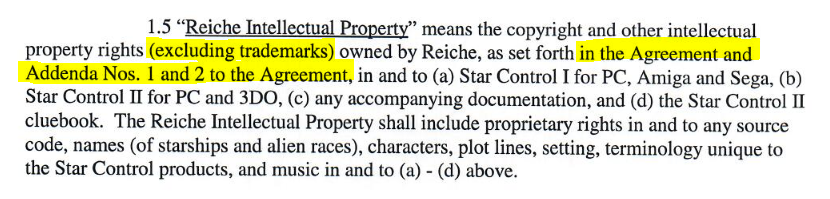
p. 62: The Reiche Intellectual Property shall include proprietary rights in and to any source code, names (of starships and alien races), characters, plot lines, setting, terminology unique to the Star Control products, and music in and to (a) - (d) above.

 - Addendum no. 3 to license agreement (https://www.documentcloud.org/documents/4385486-2635-000-P-2018-02-22-17-Counterclaim.html)

---

Legally binding or not, it seems very clear what the intent of the original contract was: The names were supposed to belong to Reiche. Accolade even licensed the names back from Reiche, at their own expense.

This language repeats in the original license agreement and all of the addendums - that just happens to be the one I have handy right now. I think I posted all of them earlier in the thread, or you can dig it up from the court documents.

I can understand Stardock's point that the contract isn't legally binding, although it still seems ethically questionable to ignore the intent. But I can't understand how you can deny that the names are explicitly intended to be part of the Reiche Intellectual Property in the contracts :)

Reply #604 Top

Quoting GMOrz, reply 603

*snip*

You should follow your own advice and read the entire paragraph.

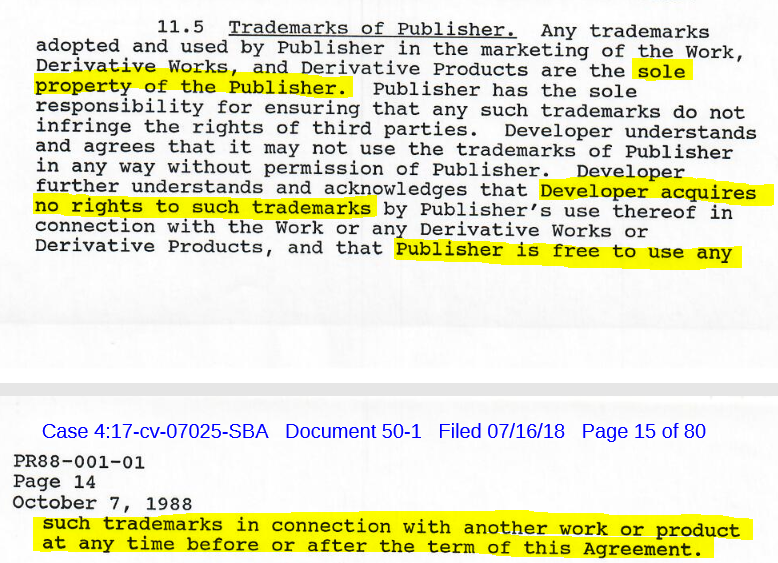
11.5 of the Agreement

Now guess which form of intellectual property covers names.

Reply #605 Top

@GMOrz: So are you saying that that agreement is live or expired? There is no such thing as Schrödinger's contract.   More to the point, and I'm not a lawyer but Addendum 3, 1998, was for a future Star Control game that was never delivered and was not one of the agreements Stardock assumed so I'm not sure what it has to do with us.

As Paul and Fred have said, they have no business relationship with Stardock.  Fair enough. Then it boils down to what copyrights and trademarks each party has.

It has also been interesting to see people discuss what is "ethical" and "moral" while defending a party that is trying to pawn off on someone else's trademark that all parties and all fans, knew belonged to Accolade and now to Stardock and is in fact suing in federal court trying to cancel that trademark.  So by all means, let's discuss ethics and morals.

+2 Loading…
Reply #606 Top

Regarding copyrights, I find this part of Stardock's complaint completely baffling:

11. [...]

Reiche represented to Accolade that he alone, as the Developer referenced in the 1988 Agreement, was the owner of the computer software programs purported to be licensed.

12. In 1990, under the terms of the 1988 Agreement, Accolade developed and published Star Control, a science fiction video game focused on space combat and featuring space ship characters, aliens and other graphics (hereinafter “Star Control I”). Despite Reiche’s representations in the 1988 Agreement that he alone owned the copyrights purported to be licensed, upon information and belief, Reiche did not own any such copyrights. Instead, numerous authors, other than Reiche and Ford, were involved in the development of Star Control I. Any copyrights arising from these authors’ contributions belonged to and were owned by them individually.

How on earth can a developer deceive the publisher about who owns which part of the copyright? Didn't Accolade know each and every developer who contributed to SC1 and SC2, since they were all listed in the credits, and weren't all copyright issues covered by the 1988 agreement? Plus, the "Copyright Fred Ford and Paul Reiche III" notices that were printed in-game, on the game boxes, and in the manuals were all presumably put there with Accolade's full knowledge and consent. How can there possibly be any misunderstanding about who owned what in this situation? Out of all of Stardock's allegations, this is by far the most puzzling and counterintuitive one.

Reply #607 Top

It's called good faith. Accolade assumed that when P&F did their code/asset drop for Star Control, every bit of IP inside were properly licensed. Or rather it's a bit more than good faith, the contract between the two required that P&F have all their i's dotted and t's crossed as far as the IP rights in the game went and that anything they included conformed to the requirements of the contract, that they deliver a game that Accolade could put the Star Control label on. The exact details of the licensing for the stuff P&F provided was P&F's responsibility to sort out, and Accolade wouldn't have been given reason to do a full audit of each and every piece of licensing so long as no problems ever cropped up with their ability to continue selling and marketing the game. The only party that directly contracted with Accolade was P&F. What P&F did to get the rest of their ducks lined up, and thereby effectively sublicense to Accolade from the people they got the IP from originally, isn't really Accolade's problem, unless P&F screwed up somehow and lawyers from the original rights holders came calling.

Reply #608 Top

Quoting PRHMro, reply 606

How on earth can a developer deceive the publisher about who owns which part of the copyright? Didn't Accolade know each and every developer who contributed to SC1 and SC2, since they were all listed in the credits, and weren't all copyright issues covered by the 1988 agreement? Plus, the "Copyright Fred Ford and Paul Reiche III" notices that were printed in-game, on the game boxes, and in the manuals were all presumably put there with Accolade's full knowledge and consent. How can there possibly be any misunderstanding about who owned what in this situation? Out of all of Stardock's allegations, this is by far the most puzzling and counterintuitive one.

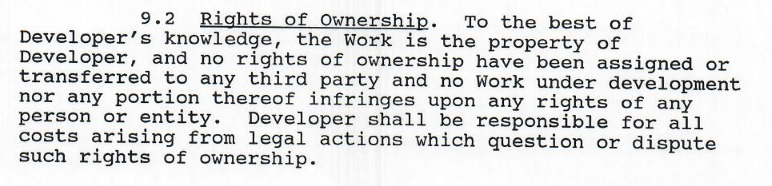
According to 9.2 of the Agreement Paul, and only Paul, was supposed to have any copyright to the product and nothing could have been assigned to a third party.

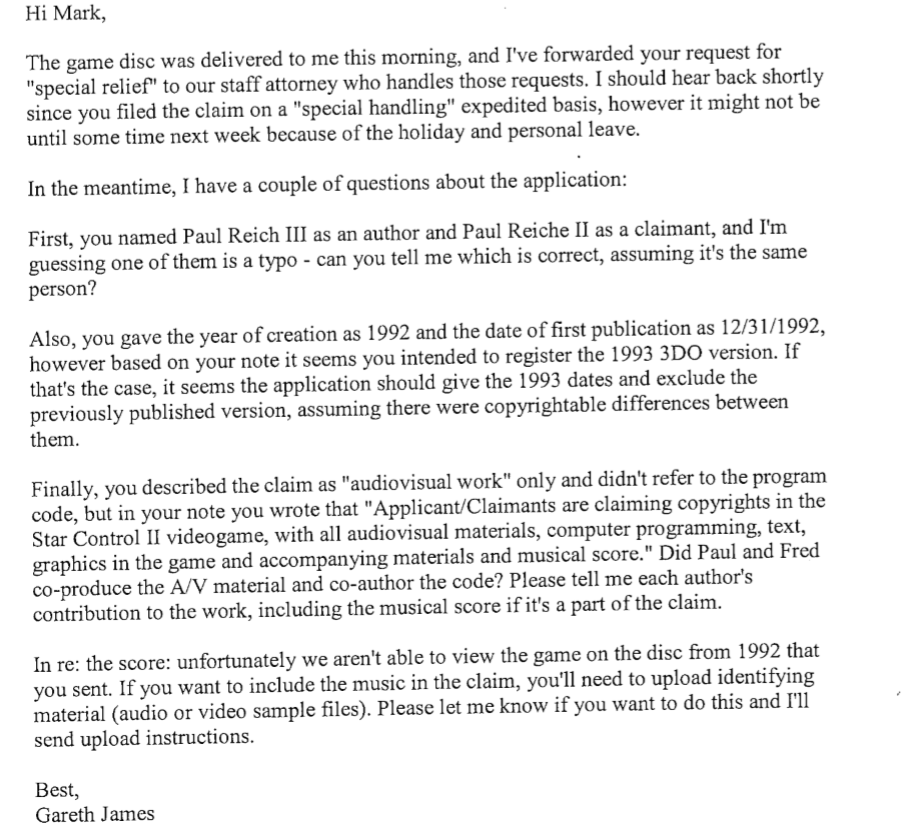
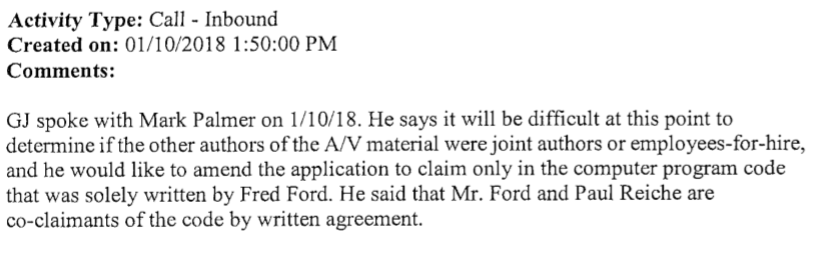
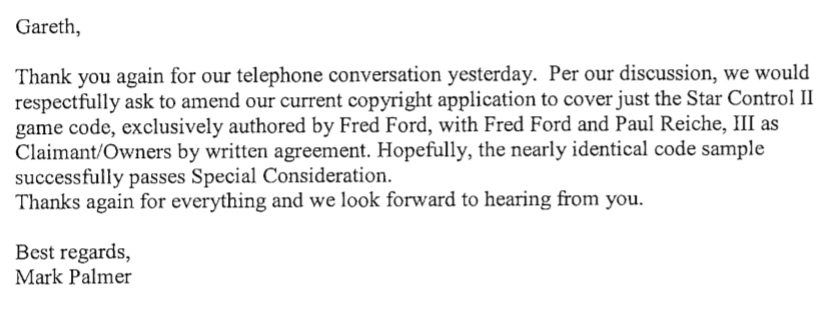
It has turned up during discovery that Paul did not have assignments for copyright from the other people that worked on the game and thus wasn't the owner of the copyright, but rather each individual owned the copyright to what they created.

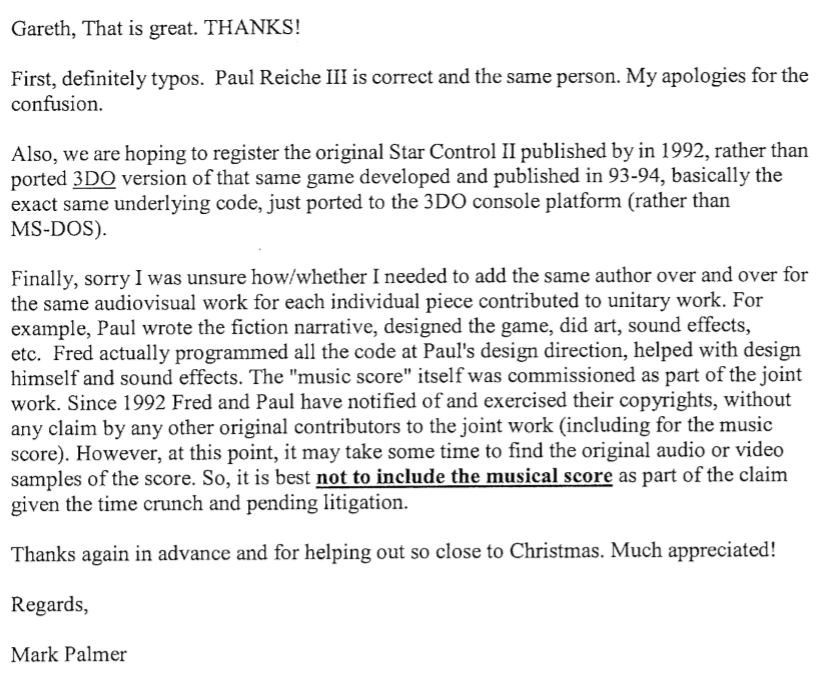
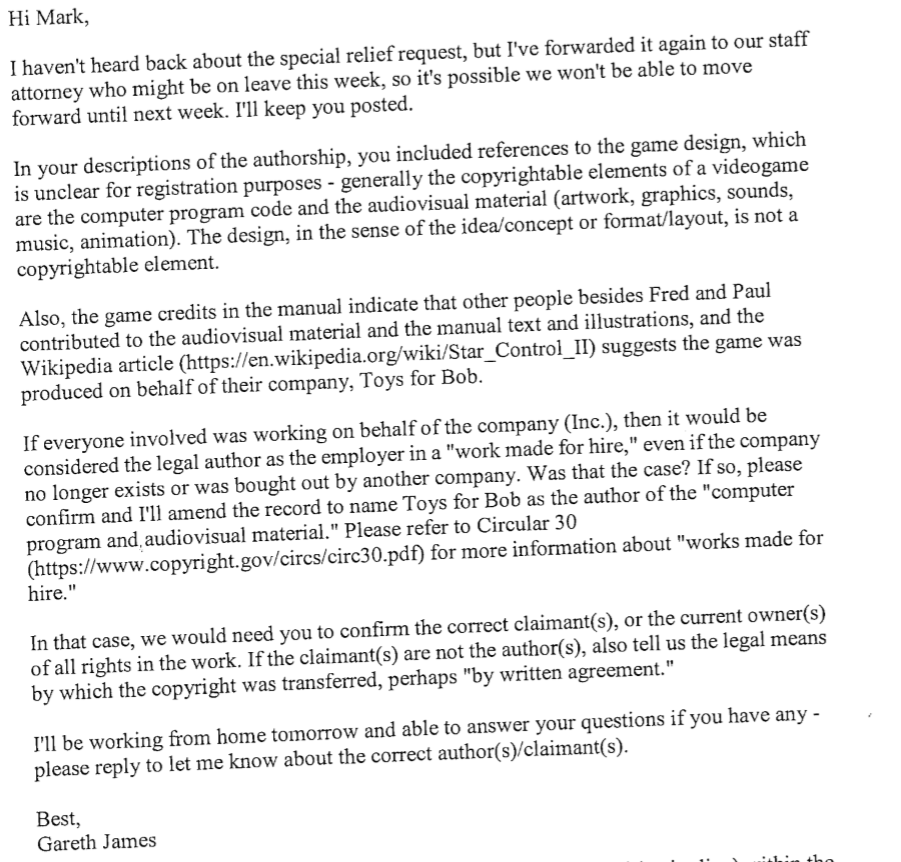
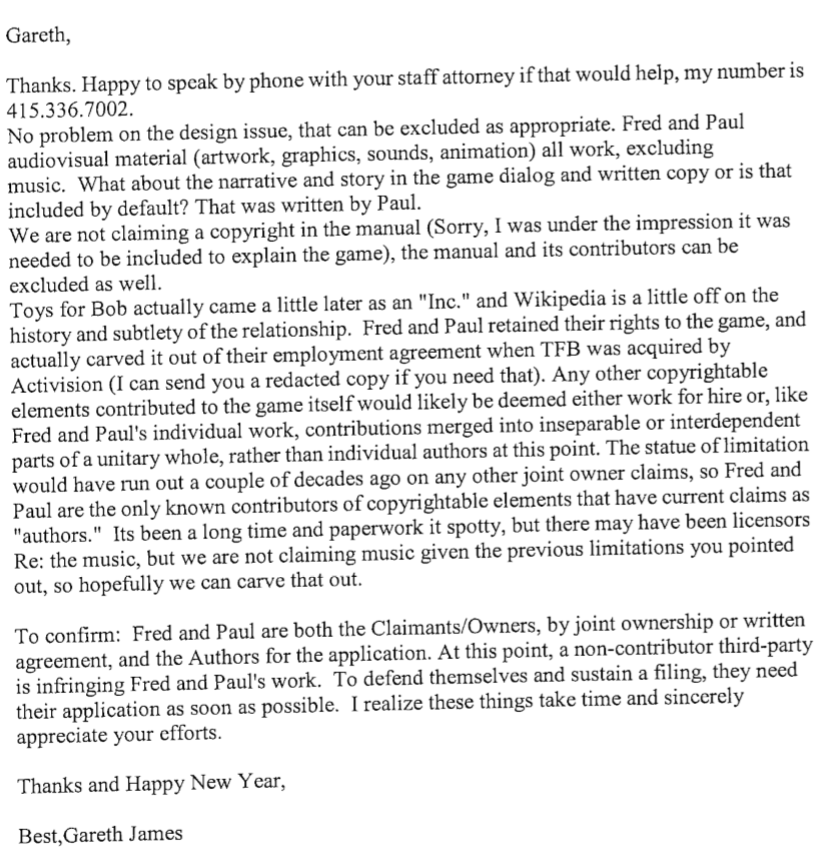
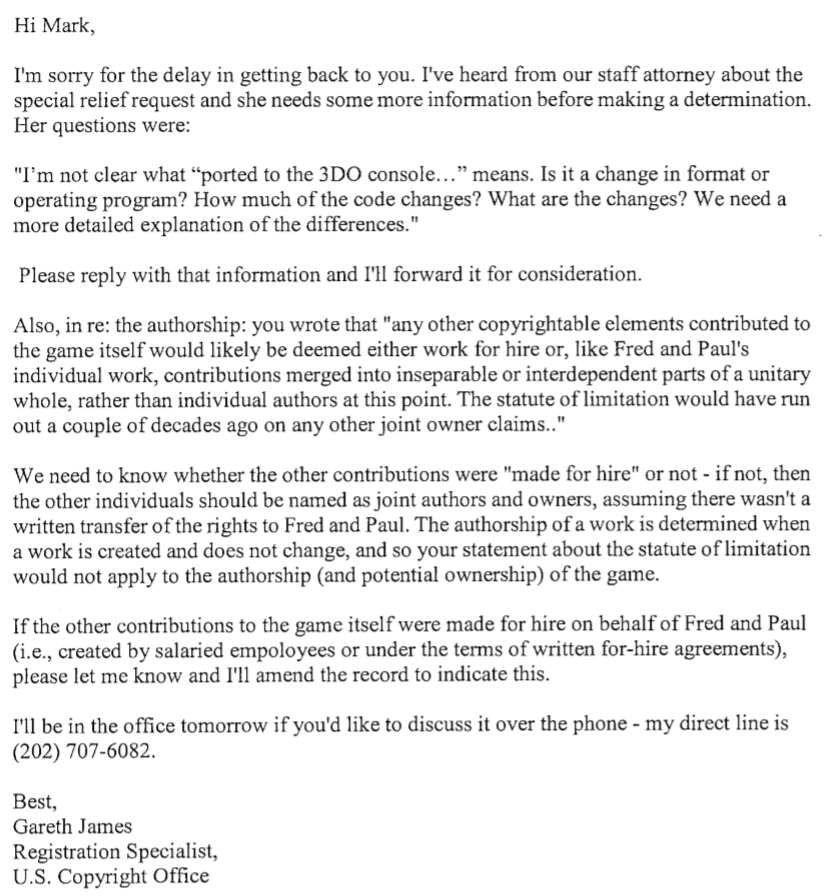
Here are some emails between P&F's lawyer and the copyright office from Exhibit T of Stardock's complaint:

Paul only got assignments in April of this year.

Reply #609 Top

Quoting Rhonin_the_wizard, reply 604

You should follow your own advice and read the entire paragraph.

By your reading, what rights to the names are granted? There's clearly a section discussing the names (as I quoted), and it assigns *some* sort of rights to Reiche.

Reply #610 Top

Quoting Frogboy, reply 605

@GMOrz: So are you saying that that agreement is live or expired? There is no such thing as Schrödinger's contract.


I'm not sure what you're referring to regarding expiration. Are you saying it was a limited-time assignment of rights that has since expired?

Reply #611 Top

Quoting GMOrz, reply 609

By your reading, what rights to the names are granted? There's clearly a section discussing the names (as I quoted), and it assigns *some* sort of rights to Reiche.

In my nonlawyer opinion, since trademarks cover names and trademarks were intentionally excluded, none.

Reply #612 Top

Quoting Frogboy, reply 602


Quoting tingkagol,

Well now that Stardock has recently supposedly "registered" trademarks* for the classic aliens (Chenjesu, Arilou, etc) your theory will no longer apply. P&F's copyrights to the aliens are now at the mercy of those trademarks in question. How convenient. ^__^


They always were, tingkagol.

I realize you spend a lot of time listening to the theories of people who have no experience at this who think there's some sort of exotic case law requirements but this situation really isn't very complicated.

The test for trademark infringement is likely confusion. It's as simple as that.

This case is a no-brainer then. I can't wait to see the judges completely junk & humiliate P&F and their claims the very moment it sees light in court - just for being an enormous waste of everyone's time.  That is of course if their measly Gofundme petition even manages to get them there, which I feel it won't, conveniently.

Reply #613 Top

Quoting Rhonin_the_wizard, reply 611


Quoting GMOrz,

By your reading, what rights to the names are granted? There's clearly a section discussing the names (as I quoted), and it assigns *some* sort of rights to Reiche.


In my nonlawyer opinion, since trademarks cover names and trademarks were intentionally excluded, none.

"WHEREAS Reiche agrees to allow Publisher to so develop Star Control using certain characters created by Reiche in Star Control and Star Control II in exchange for Publisher paying Reiche certain royalties"

"2. License Grant. Reiche hereby grants Publisher the sole and exclusive license in the Territory to use, modify, duplicate, produce, package, promote, market, display, distribute in any manner, including electronic distribution, license, and sublicense all characters, names, likenesses, characteristics, and other intellectual property rights pertaining to Star Control I and Star Control II in which Reiche has an ownership interest."

- Addendum No. 2, for Star Control 3's development.


Accolade paid a $15,000 advance plus a royalty schedule to license something from Reiche, when they made Star Control 3. What, exactly, is Stardock claiming was licensed here? I'd consider SC:O's Arilou just as derivative as SC3's Orz were, so it's presumably not just the copyright to the exact visual representation.

Reply #614 Top

Presumably the copyright. Reiche held a copyright for the media used in SC1 and 2, and Accolade acquiring a license would be them dotting their own i's so that if they reused any material from SC1 or 2, they'd be in the clear. The original agreement with Accolade only permitted the use of the material in SC1 and 2 in SC1 and 2, not in another game that had no involvement from P&F.

Reply #615 Top

Quoting GMOrz, reply 613

Accolade paid a $15,000 advance plus a royalty schedule to license something from Reiche, when they made Star Control 3. What, exactly, is Stardock claiming was licensed here? I'd consider SC:O's Arilou just as derivative as SC3's Orz were, so it's presumably not just the copyright to the exact visual representation.

Indeed. Reiche represented he owned a lot of things that he did not.  What you should ask if did they pay the copyright holders that $15,000?  We haven't found any evidence that they paid the actual copyright holders whose work they licensed to Accolade.

Trying to say that our Arilou are a derivative of SC2's Arilou is ridiculous.  Do you have a the super-secret copy of the game?  All you know is that there's a grey-style alien that has been given the name Arilou.  

Let me give you my NON-lawyer two-cents on what you can and can't have in Star Control: Origins.

Star Control: Origins could not have a Hawaiian caterpillar style alien species that has been split between green and black races that was enslaved for thousands of years via a mind controlling alien that forced them to do unspeakable things that now has a doctrinal conflict regarding whether to ensalve or annihilate all things they consider threats.  I don't know if doing that would be illegal or not but I wouldn't be willing to do it because I'm not interested in trying to use lore from SC2 or the aliens as depicted in SC2. 

However, Star Control: Origins can certainly have a 3-eyed species that operates a vast spy network throughout the mid-Spur that comes from a planet with extremely low gravity which gave them an immense advantage in space travel early in their history due to not having to care about artificial gravity for long space flights which, combined with the fact that they're the size of your fist, allows them to operate easily in a wide range of environments.

The spymasters look like this:

And they're called the Melnorme.

Star Control: Origins is the third Star Control game that has a plot of some kind (SC1 was more of a strategy game).  Each game has had its own ideas on how the Star Control aliens should be expressed.

That said, regardless of whether Paul owned the necessary IP to license to Accolade for Star Control III, the fact is, as far as I know, Star Control III did have Fwiffo and did have Ur-Quan that were clearly derived from the setting and story from Star Control II.  I doubt that those are actually protectable by copyright.  Contrary to dreams of "Your Ur-Quan are just as protectable as James Bond or the Batmobile!" that Ford and Reiche may dream, they're not.  Not even close.  But Stardock isn't going try to use the lore, setting or characters from SC2 because frankly, we don't want to.

But the trademarks related to Star Control are ours. The language is crystal clear on that.  And while the hard-core fans will object that our depiction of the Melnorme is not "canon" to how it was in SC2, we have our own ideas on how the Star Control aliens should be expressed.

But we've already seen this sort of thing happen before and fans didn't care.  The Klingons in TOS are completely different from the Klingons subsequently.  Not just in how they look but their entire backstory.  Even their homeworld (Kling vs. Chronos).  So let's not pretend that there's going to be a riot that our Melnorme are 3 eyed, small spymaters instead of a one eyed space infomerchant of some kind.  Or that the Arilou are now cryptic grey-style aliens versus the green space pixies they were in SC2.   

Most fans care that there's an alien species called the Arilou.  And as you know, we originally weren't going to use any of the Star Control aliens.  This only became necessary because Paul and Fred and their fans attempted to try to create the impression that Star Control: Origins has no relationship to the classic Star Control games. 

Star Control wasn't some abandoned domain that we scooped up.  Star Control is a beloved Sci-Fi space RPG that was being actively sold on GOG at the time we acquired it from Atari with Atari clearly owning Star Control in relationship with those classic games.   

There should be no ambiguity here.  Just like Activision acquired Spyro the Dragon which is the game Toys for Bob is working on right now from Insomniac, Stardock acquired Star Control from Atari.  It is irrelevant whether the source code or pieces of art from the classic game was copyrighted or not by someone else.  Just like it doesn't matter whether Activision gained the rights to whatever source code was using in the original or acquired every imaginable relevant copyright.   We're not using any of it.  

Probably the only thing we'd use if we owned all the SC2 copyrights might be to put the ships in Origins.   But that would be largely for nostalgia purposes only.


Reply #616 Top

Quoting Frogboy, reply 615

This only became necessary because Paul and Fred and their fans attempted to try to create the impression that Star Control: Origins has no relationship to the classic Star Control games. 

You say "create the impression" as though the original design for SC:O (pre-Arilou) had any relationship to the classic Star Control games. I'm not sure what connection you're seeing here? Obviously they both bear the name "Star Control" and certain game play similarities, but I don't think anyone has ever contested those relationships. My understanding is that SC:O is a completely different universe, and indeed bears no relationship at all to the classic games.

Reply #617 Top

That's literally the friggin' point. As Brad and others from Stardock have stated numerous times, SCO was created in a manner wherein it would still be possible for P&F to reuse the lore from the original games for their own game, either as an actual Star Control game if they did it under the auspicious of Stardock itself, or as a completely separate franchise if they didn't want to go down that route. Stardock had however reached a point in SCO's development where the Star Control trademark itself is not something it was willing to give up anymore, so if P&F wanted to make a game without Stardock, they would have needed to disassociate the lore and etc from the Star Control trademark, which prior to this charlie foxtrot Stardock was willing to let them do.

Instead P&F decided to start promote their game as a Star Control game, despite having no rights to the trademark, and also promoted it in a manner that drew a visible, prominent connection between the lore and the trademark. The moment they did this, Stardock was legally obliged to get them to back off to protect their ownership of the mark. P&F then elected to escalate, while continuing to use the lore and other material from SC1 and 2 in trying to threaten the mark, further entangling the two, to the point where as part of their defense, Stardock is further obliged to restrict P&F's ability to use that lore under any different context. P&F scored a massive own goal as far as being able to cleanly separate the lore from SC1 and 2 from the actual trademark, and have effectively prompted Stardock to now enmesh what they can of the lore, such as race names and etc, into Stardock's own vision of Star Control, in order to secure the mark.

While in the past it might have been possible to have an "arilou" in some hypothetical GotP game by disassociating it and others from the Star Control mark, the situation now is that P&F's vision for what an arilou is/was is now effectively non-canon beyond the material inside of SC1 and 2. Whatever their intentions, whatever direction they wanted to take that race, the only "true" arilou in a Star Control context would be whatever Stardock chooses to acknowledge from SC1 and 2 and continue on into their own Star Control games.

Reply #618 Top


drew a visible, prominent connection between the lore and the trademark. The moment they did this, Stardock was legally obliged to get them to back off to protect their ownership of the mark.


Huuuh, I'm not familiar with that legal theory. Could you offer some sort of citation? I would have thought the original games already created a connection between the lore and the trademark.

Reply #619 Top

Quoting GMOrz, reply 618


drew a visible, prominent connection between the lore and the trademark. The moment they did this, Stardock was legally obliged to get them to back off to protect their ownership of the mark.


Huuuh, I'm not familiar with that legal theory. Could you offer some sort of citation? I would have thought the original games already created a connection between the lore and the trademark.


Can you provide a citation for your belief, GMOrz? 

Reply #620 Top

I was referring to the lore intended for GotP. They were already on shaky legal grounds because of that material's connection to the material in SC1 and 2, which is without question tied to the trademark, but it would still have been possible to make a game, WITH the agreement of Stardock, the owners of the Star Control trademark. Whatever P&F wanted to do with the SC1 and 2 material, they would have needed Stardock's agreement. That point I have consistently emphasized throughout, along with the point that P&F's IP rights are useless with respect to reusing the material from SC1 and 2 in a new venture. They were always at the mercy of whoever owned the Star Control trademark, and will be even more so now that they drew such a blatant connection between the game they supposedly want to make and the trademark's associated material.

Reply #621 Top


Zwabbit that is a succinct picture of how things are and will be. We have been accused of only being Brads echo chamber here on this forum by the reddit an UQM forums folks. They clearly think that the law is completely different and that the outcome can and will be at right angles to what Brad has stated.


For example Elestan continues to say the that the trademark is in question on who owns it. This is lunacy at its worst. There is zero question on who owns the trademark. 

Then we get into them saying the mark has no power and its copyrights that allow use of ideas or such. What boggles me is that both Elestan and Lakstiotes, Forgotten Pants, and others refuse all outside court submitted info saying the court has to determine who is lying..


"And if they want to make GotP they can swallow thier pride and do what any other developer who needs a liscence for software does and get one from Stardock."


 Elestan  says>>  "There are quite a number of reasons why Stardock's trademark rights on the alien names could fail. However, Brad has a tendency to talk as though the court had already affirmed his incontestable right to those names, when the judge has probably barely looked at the briefs yet. Until the court rules, that sort of talk on his part just comes across to me as either arrogant (by presuming how the court will rule) or deceptive (by trying to draw a false equivalence between Stardock's unproven IP rights and the proven rights of other franchises like Unity or Unreal)."


^^^ The above is an example of Elestan talking down to me regarding the simple fact that all F&P have to do is ask for a licence and i get that response. 


Reply #622 Top

Quoting zwabbit, reply 620

I was referring to the lore intended for GotP. They were already on shaky legal grounds because of that material's connection to the material in SC1 and 2, which is without question tied to the trademark, but it would still have been possible to make a game, WITH the agreement of Stardock, the owners of the Star Control trademark. Whatever P&F wanted to do with the SC1 and 2 material, they would have needed Stardock's agreement. That point I have consistently emphasized throughout, along with the point that P&F's IP rights are useless with respect to reusing the material from SC1 and 2 in a new venture. They were always at the mercy of whoever owned the Star Control trademark, and will be even more so now that they drew such a blatant connection between the game they supposedly want to make and the trademark's associated material.

I occasionally read over the various legal conjectures by Paul and Fred's fans over at the UQM forums.  There is a lot of exotic and interesting legal theories that get thrown about on what is a fairly straight-forward IP case. 

It only appears complicated because Paul and Fred's counter-complaint is essentially a legal strawman that they then knock down.

We don't want anything to do with any of the copyrightable material in Star Control 1, 2 or 3 (which we own).  That's why Origins takes place in a new universe.

Unfortunately, Paul and Fred have pursued a misleading strategy of trying to get fans to believe we're somehow "stealing" from them rather than acknowledge the straight forward facts: We own the Star Control trademarks.  They own whatever copyrights they have.   

Paul and Fred, through their misleading public statements and very public smear campaign have created the conditions that have resulted in people suggesting boycotts, Steam review bombing, smear videos, etc. 

It is worth noting that other than Elestan, every active anti-Star Control: Origins poster on the UQM forums showed up after Paul and Fred's professional PR campaign (back in February).  You can actually check the posters in this thread over there to verify for yourself.   The argument that "Stardock brought it on themselves" would only hold water if these people had shown up in December (when Stardock filed its complaint).  

While Paul and Fred have described our defense of our own trademarks as "aggressive", we have been doing our best to be as gentle as we possibly can while protecting ourselves from their explicit effort to deprive us of the very trademark that everyone recognized us as having acquired for hundreds of thousands of dollars and invested over $10 million into over the past five years.

My friends and colleagues have spent the past four years of their lives working on a new Star Control game.   Paul and Fred's ego are not worth their livelihoods.   You can be assured that if Paul and Fred carry out their intention to wreck our launch with their fans, there will be serious financial consequences for them. 

They should spend less time trying to stir up the fan base and more time making their new game that they claim to want to make (which to date they've shown no evidence of having done anything on).   Harming us will not do them any good. Quite the opposite.  Their fans that believe continuing to spread false and misleading statements or sabotaging reviews and coverage for the new Star Control will find that those efforts will only result in less willingness on part to support the very things they want to happen.


+1 Loading…
Reply #623 Top

@Frogboy

Quite point of clarification for my curiosity, when you say "they then knock down." Which "they" are you referring to?

Reply #624 Top

Quoting zwabbit, reply 623

Quite point of clarification for my curiosity, when you say "they then knock down." Which "they" are you referring to?

Paul and Fred.  Their counter-claim essentially posits that Stardock believes it owns their copyrights and then meticulously sets up why it doesn't when in fact Stardock has no interest in their copyrights.


Reply #625 Top

Activision and Spyro might not be the best example to use. Technically the same studio has owned them since their creation. Universal just went through a string of corporate buy-outs which ended with them in Activisions hands. The IP was never individually sold as Universal owned it, not Insomniac, they were only contracted by Universal to create the game.

I do get the main point tho. Stardock owns the IP via the bankruptcy sale when Atari went down the gurgler. Which, as long as the courts agree Atari had said IP rights to sell, seems to be a no brainer that it's theirs to use as they see fit. Without using any potentially copyrighted material like story, scripts or identical charactization etc Stardock isn't breaking any laws or breaching any existing copyright.

I love Starcontrol as much as anyone here, Starcontrol 2 is one of my favourite games of all time, and my #1 favourite PC game which I revisit often. I'm also looking forward to how Fred and Paul continue their story via their new game as much as any fan. But that's no reason to hate on Stardock for enforcing their legal rights. Plus surely it's a win win for fans in general, we get a potential follow-up to Ur-Quan Masters (if this new game is followed through) and an alternate time-line/dimension/universe Starcontrol from Stardock that from what I've experienced so far draws a lot from my favourite game in the original series. How is this a bad thing? 

+2 Loading…