DeepSpaceNine DeepSpaceNine

Q+A regarding Star Control and Paul and Fred

Q+A regarding Star Control and Paul and Fred

Given the ongoing discussion of the legal dispute between Stardock and Paul Reiche and Fred Ford, designers of Star Control I and II, I wanted to take time to make Stardock's position clear and address inaccuracies that have been promoted.

As the need arises, I’ll continue to update this post with additional questions and answers.

Q: What are the issues in dispute?

A: On the eve of launch of the beta of Star Control: Origins in October 2017, a game Stardock has spent the past four years working on, Paul Reiche III and Fred Ford, the designers of Star Control II for Accolade 25 years ago announced a new game, Ghosts of the Precursors as a “direct” sequel to Star Control even going so far as to promote it as Star Control: Ghosts of the Precursors.

They did this despite knowing Stardock had acquired the Star Control IP in 2013 and knowing before hand our announcement schedule. Their actions created confusion in the market as to the origin of Star Control games which is why we have trademark laws. 

When Stardock asked that they cease and desist marketing their game as a sequel to Star Control they refused and began demanding that the sale of the DOS games, which had been on sale continuously since before Stardock acquired the IP and for which they had been receiving royalties for during the entire time cease and began to disparage Stardock publicly in the press. 

Despite Stardock's best efforts to reach a private, mutually beneficial co-existence agreement, Paul and Fred responded with increasingly hostile, misleading public attacks and served Steam and GOG with DMCA take-down notices on all of the classic DOS games, including Star Control 3 which they had no involvement with all while continuing to promote their new game as the "true" sequel to Star Control.

In addition, Paul Reiche and Fred Ford also began to claim that various features of Star Control: Origins violated their copyrights such as the ship designer, user interface similarities and other elements that are not subject to copyright protection (you can’t copyright an idea and Star Control itself was inspired by many other games). They also began to demand special access to Star Control: Origins to inspect it and demanded the removal of the ship designer,

As a result of their broad interpretation of what they believe they have rights to combined with their willingness to instruct their lawyers to issue a DMCA take down notices, even on titles in which they had no involvement in, combined with their refusal to cease promoting their game as the sequel to Star Control, Stardock was forced to file a complaint over their continuing trademark infringement.

In retaliation, Reiche and Ford filed a countersuit seeking to cancel the Star Control trademark and for copyright infringement due to the sale of the classic Star Control games on GOG and Steam and are even suing GOG despite the fact that Reiche and Ford were the ones who claim to have helped get the classic Star Control games onto GOG.

Q: Why did Stardock file the initial lawsuit against Paul and Fred?

A: We had no choice after Paul and Fred filed DMCA claims against the distribution not only of Star Control 1 and 2 but also Star Control 3 which they admit they had no involvement.  The DMCA claims were reversed, but it was clear that our ability to create more experiences in the Star Control multiverse for fans would be at risk if they are allowed to continue to misrepresent their new game as being associated with Star Control without a license while simultaneously making broad, unsupportable claims of ownership on ideas and concepts that are present not just in Star Control games but games in general.  

Q: How did these unfortunate events come to pass?

A: Here is a timeline of the order of events:

  1. Stardock acquires the Star Control brand, copyright to Star Control 3, the license to use the Star Control classic characters, lore and the right to distribute the classic DOS games.  The DOS games are already available on GOG  with Atari listed as the publisher. (2013)
  2. Stardock discuss plans for the new Star Control.  They state that their employment by Activision prevents them from working on a new Star Coxntrol game and request that we not use the aliens from Star Control 2 but do not contest Stardock's right to do so.  (2013)
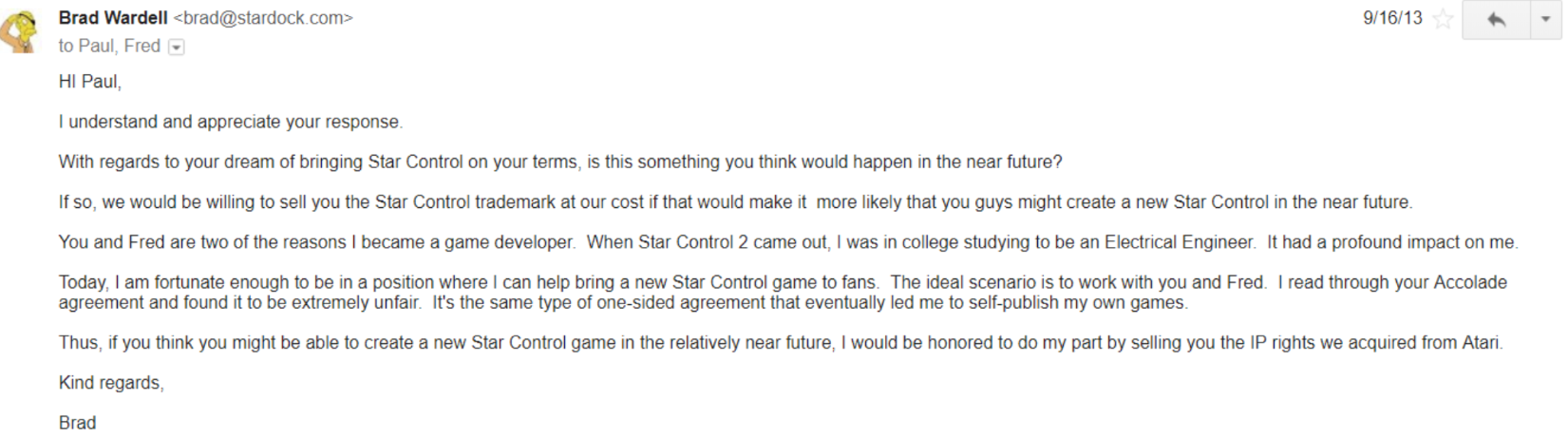
  3. Upon learning that Activision has blocked their ability to be involved and that Paul and Fred hope to one day to continue their stories, Stardock offers to transfer its rights to Star Control to them, thus uniting the Star Control brand with Paul and Fred's licensed IP.  (2013)
  4. Paul and Fred ask what Stardock acquired from Atari to which Stardock responds: The trademark, assets to Star Control 3 and the right to sell distribute, market and promote the original trilogy.
  5. Paul acknowledges Stardock's position and asks how much it cost.
  6. Paul and Fred politely decline the offer to acquire the Star Control IP. (2013)
  7. Stardock announces a reboot of Star Control and explicitly states that it will not include the characters from the classic series out of respect for Paul and Fred. (2013)
  8. Stardock spends the next 4 years and millions of dollars developing Star Control: Origins. (2013-2017)
  9. Stardock provides Paul and Fred regular updates on progress including video of pre-alpha footage, design notes, screenshots.  Relations are amicable and supportive. (2013-2017)
  10. Stardock updates Paul and Fred on Star Control: Origins release schedule and begins planning its 25th anniversary which will include releasing the classic games onto more channels.  Stardock asks if there would be any interest in having SC2 ships appear in Super-Melee. The games are submitted and approved by Steam in preparation (Summer 2017).
  11. Paul and Fred contact Stardock to inform them that they will be announcing a new game that will utilize the characters from their universe.  (Fall 2017)
  12. Stardock is both pleased and concerned about the timing of their plan, points out the licensing agreement would allow Stardock to use their IP (albeit at a higher royalty than Stardock was hoping for). Stardock asks that they coordinate these announcements together ensure there is no confusion and about the games appearing competitive. (Fall 2017)   
  13. Paul and Fred state they plan to make a sequel to Star Control II which would violate Stardock's trademark rights (you can't claim your product is a sequel to another company's product).  Paul and Fred also assert that Stardock does not have a license to their IP.
  14. In the email below Paul and Fred state that each party should work within its respective rights: Stardock having the Star Control trademarks and Paul and Fred owning all the IP rights to the works they created. Note that at this point, Paul and Fred recognized that owning the registration to the Star Control trademark also includes many common law trademarks. Hence "trademarks" plural.
  15. Stardock responds stating that as far as Stardock is aware, while Paul and Fred own the IP they created, Stardock does have an active licensing agreement that controls how that IP can and can't be used.  Stardock also reiterates that it has not used this license out of respect for Paul and Fred. (October 2017)
  16. Stardock states its concern at the idea of Paul and Fred representing their game as a "direct sequel", asks to schedule a call to discuss.  Note that at this point, Brad, like many, is under the impression that Paul and Fred essentially created Star Control on their own, a two-man team with licensed music was not uncommon thing back in 1992 (Stardock later re-evaluates that position after learning that the project had a large budget for 1990 and immense talent on it). (October 2017)
  17. Paul and Fred respond that they simply don't agree but provide no evidence as to why the licensing agreement would have expired. (October 2017)
  18. Stardock provides its reviewed legal position.  Stardock isn't using any IP from the classic games other than the right to market and sell them as they have been for several years.  (October 2017)
  19. Stardock points out that it has a license to the IP to use provided it pays a royalty of 10% (which is why Stardock has asked in the past for a new licensing agreement as 10% is too much for a cameo of a classic character). Stardock CEO, Brad Wardell suggests talking on the phone to iron things out. (October 2017).
  20. Email includes proposal:
  21. Paul and Fred refuse Stardock's proposal and begin to demand changes to Star Control: Origins.
  22. Paul and Fred, knowing the date Stardock was planning to announce the Fleet Battles beta, preemptively announce Ghosts of the Precursors as a direct sequel to Star Control II; use the Star Control II box (which is owned by Stardock) as the only art on the page for it; promote it to the media and to social media as the "true" sequel to Star Control.  (October)
  23. Despite having just stated that their efforts should be "separated" by each parties rights (Stardock with the trademarks) Paul and Fred almost immediately violate that understanding by using the Star Control trademarks throughout their announcement.
  24. The Star Control trademark is mentioned 4 times in the announcement, each with an (R) without mentioning Stardock leading a reasonable consumer to believe it is their mark (Ghosts of the Precursors is listed once). 
  25. Paul and Fred claim they "released" Star Control II on the same page that shows Star Control II with the Accolade mark misleading the relationship between Accolade and Paul and Fred (who, regardless of their tremendous work, were contracted by Accolade to create content that was then licensed into Accolade's product).
  26. The media follow-up by referring to it as "Star Control: Ghosts of the Precursors". (October)
  27. Paul and Fred promote the idea that it's Star Control: Ghosts of the Precursors and not its own game:
  28. The above is one example among dozens.
  29. Paul and Fred publicize coverage of their new game with each post using the Star Control mark but not a single one using the term "Ghosts of the Precursors".  Looking below, what's the name of their new game?
  30. Many posts and articles appear, endorsed by Paul and Fred that state that their new game is a "direct sequel" to Star Control.  Some refer to it as Star Control: Ghosts of the Precursors.
  31. Stardock moves forward on its 25th anniversary plans, release the beta of Star Control: Origins - Fleet Battles beta and relaunches the classic DOS games for the 25th anniversary on Steam. (October)
  32. Paul and Fred's attorney contacts Stardock's CEO.  This is the first time lawyers have been involved.  Lawyers take over. (October)
  33. Paul and Fred begin to demand that Stardock begin policing the Star Control community for fan art that they believe violates their rights (including members of this forum and on Steam). (October)
  34. Paul and Fred begin demanding the removal of features from Star Control: Origins including the ship designer (a feature that has been part of Stardock's games for over a decade). (October)
  35. Paul and Fred begin demanding insider builds of Star Control: Origins for inspection and begin insisting various broad features are their property despite having no right to do so. (October)
  36. Paul and Fred reject numerous attempts to create a co-existence agreement that would permit Ghosts of the Precursors to go forward independently.   (November)
  37. Paul and Fred insist they have the right to associate their game with Stardock's trademarks including referring to their game as the "true" sequel to Star Control. (November)
  38. Paul and Fred demand that the DOS games be removed from distribution while still providing no evidence to support their claim that the agreement had expired. (November)
  39. Paul and Fred begin to make public defamatory blog posts and tweets about Stardock. (December)
  40. Paul and Fred file DMCA notices against Steam and GOG not just for Star Control 1 and 2 but also Star Control 3 which Stardock holds the federally registered copyright for and that Paul and Fred had no involvement in. (December)
  41. Stardock's attorneys file a suit against Paul and Fred for trademark infringement and other causes of action. (December)
  42. Paul and Fred's attorney files a lawsuit against Stardock alleging copyright infringement and other causes of action. (February).
  43. Paul and Fred's PR firm releases a press release to the wire services accusing Stardock of "copyright theft" do press interviews attacking Stardock. (February)
  44. This post is initially made. (February)
  45. Paul and Fred post an email exchange they claim is between themselves and Atari, something they had not shown to Stardock and still have not provided to Stardock to evaluate. 
  46. Paul and Fred post what they claim is a Stardock settlement proposal in violation of federal rule 408. Stardock denies the accuracy. (March)
  47. Paul and Fred's PR firm targets Stardock CEO, Brad Wardell personally on Twitter for abuse with an inflammatory and completely inaccurate social media post. (March)
  48. Paul and Fred like a tweet that purports that these activities have cost Stardock up to 50% of potential sales and may lead to review bombing of the final game:  (March)
  49. To make clear that Stardock's concern is regarding the protection of its Star Control IP and not the sales of Star Control: Ur-Quan Masters, it decides that it will be suspend sales of the classic games until the dispute is resolved starting April 4. (March 2018).

Q: Don't Paul and Fred contend that the 1988 licensing agreement with Accolade has expired?

A: That is their position.  However, since the dispute began, Stardock has chosen to err on the side of caution and operate as if that is the case.   Stardock requested that GOG and Steam remove the games for sale pending a resolution.  The 1988 agreement, however, does not have anything to do with the Star Control trademarks were were always owned by Accolade and were assigned to Stardock.   

Stardock's ownership of the Star Control trademark is incontestable.  You can review the federal registration that dates back to the 1990s here.

Q: But isn't it true that Star Control: Origins has very similar gameplay to Star Control II? That you explore planets, travel through hyperspace to different star systems, meet with aliens? Couldn't their copyright of Star Control II mean that Star Control: Origins is too similar?

A: You cannot copyright an idea.  Putting aside that Star Control itself borrowed many ideas from many other games, copyright protects creative expression. Not game play.  

There are articles you can read that discuss this:

https://en.wikipedia.org/wiki/Video_game_clone 

https://venturebeat.com/2013/03/16/defeating-mobile-game-clones-why-copyright-protection-is-not-enough/ 

https://gamedev.stackexchange.com/questions/11752/is-it-legally-possible-to-make-a-clone-of-the-game 

Obviously, anyone who has ever played Angry Birds or Candy Crunch already knows this.

That said, Star Control: Origins is not a clone of Star Control II.  The 25-year gap in game technology allows Star Control: Origins to deliver a much richer experience.  So while the core concepts remain true: You are the captain of a starship traveling through this part of the galaxy, meeting aliens, engaging in battles, exploring planets, the implementation is very different.

In short: Gameplay clones aren't illegal and even if it were illegal, Star Control: Origins is not a clone. 


Q: Why does Stardock claim that Paul and Fred were not the creators of Star Control?

A: Paul and Fred were the designers of Star Control I and II.  In the credits, on the box and elsewhere they had previously officially listed themselves as either developers or designers.  

While Stardock has no objection to “creators” in the casual sense, legally, and when trying to promote a product in commerce, they are not. Most of the Copyrighted material people think of as being important to Star Control was created and owned by others. 

For 25 years, Designer was their official designation.   

It is Stardock's opinion that they have begun to focus on referring to themselves as "creators" in their marketing in order to give the impression that Ghosts of the Precursors would have the the same creative core as Star Control II.   This is not the case.

What most people do not realize is Star Control II had, in essence, the dream Sci-Fi team as mentioned in this 25th anniversary tribute. The lead animator went on to lead the animation at Pixar and is the director of the Minions movies.  Many of the alien designs were created by the artist who went on to design Darth Maul and other Star Wars and Marvel movie characters.  Many of the most quoted lines came from seasoned Sci-Fi writers.  The engaging music was created by others.

We respect Paul and Fred’s crucial contributions as well as the rest of the talented team who worked on Star Control.  

Q: Who owns the Star Control trademark?

A: Stardock is the legal owner of the federally registered trademark for Star Control.  You can view it here. https://www.trademarkia.com/star-control-75095591.html 

Q: What does Stardock want out of this lawsuit?  

A:  Our ONLY goal is to protect our ability to tell more stories in the Star Control multiverse.  We remain fans of Paul and Fred and their contributions to Star Control.  However, given the confusion they’ve created in the market by promoting their new game as a “true sequel” to Star Control II combined with their abuse of the DMCA system to take down even Star Control games they had no involvement with, we are forced to act to prevent them from continuing to create confusion.   

Consider some of your favorite games or movies. Now imagine if someone instrumental to the development of that game or movie went on to claim to be making a sequel to that game or movie without the consent of the owners of that trademark? What would be the result?

Q: But doesn't Paul and Fred own all the in-game IP?

A: Paul and Fred own whatever IP they created.  What that is remains to be seen. Stardock does not claim to own any copyrighted material within Star Control II which is why the new Star Control: Origins is set in its own universe with its own characters and story.

However, as of April 2018, neither Paul or Fred had any rights to any of the art and much of the writing in Star Control II. However, even if they did, it would be irrelevant as Stardock isn't using any copyrighted material from Star Control 1, 2, or 3 in the new Star Control games.

On the trademark side, simply because you were contracted to work on a game does not grant you the right to make a new game and claim it is related regardless of what copyrights you think you may own (otherwise, you could argue that Unity and Epic could start to make sequels to other people's games).

For example, Paul Reiche is the President of an Activision studio.  Blizzard is another Activision studio.  Stardock was once contracted to develop a StarCraft expansion (StarCraft: Retribution). One can imagine the response Stardock would receive it it were to announce a new game as a "direct sequel" to StarCraft: Retribution.

By contrast, not only did Paul and Fred announce their new game as a "direct" and later "true" sequel to Star Control, they even used the Star Control II box, that was acquired by Stardock, to promote it.

As much as we respect Paul and Fred, the fact is, Paul Reiche was contracted as an independent contractor (not as a company) by Accolade to develop Star Control for Accolade.  This is a fairly routine method that developers get products made (Stardock's own Fences, WindowBlinds, Groupy, IconPackager, etc. were developed using the same method).

Q: Do these legal issues have any impact on Star Control: Origins?

A: UPDATE:

Apparently yes.  Despite Star Control: Origins having nothing to do with Reiche and Ford's games, they have filed DMCA take down notices to Steam and GOG to take down Star Control: Origins.  They claim (with not specificity) that they own copyrights in Star Control: Origins

Game sites don't make legal judgments on the merits.  They simply remove the content.  No one, to our knowledge, has ever tried to do this on a shipping game before.  

You can read our response here.


Q: Why did Stardock trademark Ur-Quan Masters, Super Melee, and other names from the original games? 

A: Once Paul and Fred began to challenge the validity of our intellectual property we were forced to take steps to solidify our common law rights. Specifically, Paul and Fred have worked to try to separate Stardock's Star Control mark from its association with the classic games.  

The reason companies were bidding to acquire the Star Control trademarks and willing to pay $300,000 for it was for the association with the classic series.  The trademarks, being in active use in connection with the beloved classic series, made it valuable.  

When Paul and Fred began to seek to cancel the Star Control mark and make public statements that Star Control: Origins isn't related to the classic series Stardock felt obligated to respond by reinforcing its intellectual property rights to the classic series.  

As background: Stardock always had the common law trademark to Ur-Quan Masters. It's the sub-title to Star Control II after all and was, by Paul and Fred's admission, available in commerce on GOG even before Stardock was involved. Super-Melee is literally a promoted feature from Star Control. The alien names are so strongly associated with Star Control that if you Google Star Control aliens they come up as the first entry.  

They have made it very clear that they believe that they have the right to associate their new game with Star Control on the basis that they have previously licensed content to Star Control games. They have no such right.

Q: Why did Stardock really need to trademark the Star Control 2 alien names?

A: Star Control fans expect new Star Control games to have the Spathi, Ur-Quan, Orz, etc.   We originally chose not to include them in Star Control: Origins in deference to Paul and Fred who asked us not to.  

However, in December 2017, Paul and Fred posted:

This creates confusion because Stardock alone owns the Star Control universe. That doesn’t mean it owns any lore or stories created by others. It just means that Stardock has the right to determine what is canon in the Star Control universe.  

The Star Control aliens are associated with Star Control. That doesn’t mean Stardock can use expressions and stories of those aliens without permission. But it does mean Stardock has the right to create its own stories and expressions for the Ur-Quan, Spathi, etc.

When Paul and Fred were contracted to develop Star Control I and Star Control II for Accolade, they were allowed to keep certain copyrights to the works they created. But all trademarks were explicitly defined as being owned by Accolade. 

Incidentally, their name was put into a diagram because they literally announced their game as a sequel to Star Control II.  They associated their new game with Star Control, not the other way around.

Q: Is Stardock trying to prevent Paul and Fred from making new games in their universe?

A: No.  Stardock wants them to create new games in the universe they created.  However, this needs to be handled in such a way that there is no confusion as to the relationship between Star Control and the works they licensed for Star Control II.

Q: If Stardock wants a new game from Paul and Fred, why did the settlement offer that Paul and Fred publicly posted that they claim came from Stardock demand that they "surrender" their IP?

A: It is regrettable that Paul and Fred chose to violate confidentiality and post, without context, a settlement offer.  Paul and Fred have been offered many settlement proposals with many different terms and are intended for negotiation by both parties to try to reach an amicable settlement.

Stardock paid over $300,000 for the Star acontrol IP which included the trademark and copyright to Star a Control 3. The Star Control brand is, in our view, far more valuable than any copyrighted material within a 25 year old DOS game. Source code and alien art. Nothing else, as far as we can discern, falls under copyright protection. You can’t copyright “lore” or timelines, or alien names, or game designs or UI.  

Thus, all we would gain would be the ability to have Ur-Quan that look just like the old Ur-Quan and space ships that look like the classic space ships. The greater value would be to make sure this kind of dispute didn’t happen again. But that value would still not overcome the damage they’ve caused in the market place due to the confusion on who owns Star Control and the ill will due to their PR company issuing false and misleading press releases and publicizing the dispute in a way to maximize ill will. Not to mention the considerable and rising legal costs.

None of this would prevent Paul and Fred from making a new game if that really is their desire. Stardock, in turn, would have been happy to license, free of charge, any IP they needed to make their new game.

Our respect for the work Paul and Fred did 25 years ago remains undiminished.  However, that respect does not give them the right to disrupt our product development at the 11th hour or misrepresent their new endeavors as the "true" sequel to our products.

Our dedication to bringing you a new Star Control game remains unchanged.  BETA 2 of Star Control: Origins is due in a few weeks.

For those interested in reading the details, our complete initial filing available online:

https://www.documentcloud.org/documents/4385277-Stardock-Legal-Complaint-2635-000-P-2017-12-08-1.html

Stardock 25th anniversary post documenting the creation of Star Control:

https://www.stardock.com/games/article/485810/star-control-ii-25th-anniversary---on-the-shoulders-of-giants  


Thank you for being fans of Star Control, and supporting our effort to make a great new game in the Star Control franchise.

And if you have questions that you’d like to see added to this post, feel free to reach out to me directly via Twitter at @kevinunangst

Kevin Unangst

Vice President, Marketing and Strategic Partnerships

Stardock Entertainment

1,790,254 views 728 replies
Reply #426 Top

Thx, edited. Hopefully it works now.

Reply #427 Top

Quoting Frogboy, reply 424
Elestan, the “fan created” page is a Paul and Fred fan created page and is filled with Internet lawyering and lay person legal conclusions.  I looked through it and it could be summed up as a tremendous amount of noise about very tiny issues. 

I’ve covered the legalities in post 259. 

https://forums.starcontrol.com/487690/page/11/#3713501
 

I don't want to try incorporating that into the wiki myself for fear that I might misrepresent you (and it would also need to have references added), but if you or someone else would like to help bring in the facts supporting Stardock's positions (with proper references), and point out any improperly supported information that's already there, it would be quite welcome.

For example, your post takes issue with the statements of Paul's PR firm (I do too, by the way).  If you wanted to cite those statements, with links or screenshots, that could certainly go in there.

+1 Loading…
Reply #428 Top

Quoting Elestan, reply 427

I don't want to try incorporating that into the wiki myself for fear that I might misrepresent you (and it would also need to have references added), but if you or someone else would like to help bring in the facts supporting Stardock's positions (with proper references), and point out any improperly supported information that's already there, it would be quite welcome.

For example, your post takes issue with the statements of Paul's PR firm (I do too, by the way).  If you wanted to cite those statements, with links or screenshots, that could certainly go in there.

I'm not going to be giving legitimacy to what is, in essence, propaganda.  Not only is it incredibly misleading, it is very unhelpful. 

I realize you may be trying to be helpful but the effect you're having on the dispute, from what I've seen, is to try to encourage us to shut down UQM (which we absolutely don't want to do) and insist on a clear court verdict in order to make clear how wrong your legal conclusions are.  Nearly all of your assumptions about the case are in error.   

You have seen me "change my position" as if it were simply because it was "convenient" (as if a jury wouldn't see through that if that was the case) as opposed to Occam's razor: We have learned things that aren't public and aren't disclosing them because we still, genuinely hope, to reach some sort of accommodation.   

Remember: We aren't trying to prevent Paul and Fred from making a game (contrary to what some of you guys seem to argue).  This dispute could be over tomorrow with just some licensing. Boom. Done.  Call it UQM II (I'd even transfer all UQM trademark ownership to help) and go do the game. But all the public escalation back and forth (and this includes so-called fans) only makes each side more insistent on going forward.

There is nothing served by having the parties (this includes me) escalating things publicly.  This is why I don't post on UQM anymore about this and why I am sticking to only comments here for Q & A.

Fundamentally: You forget who are the biggest PF fans out there. Us. We're the ones who acquired the Star Control IP and were willing to transfer at cost to help make a new game from PF happen and we can prove it.

You an argue with yourself over and over but it pretty obvious that both sides understood we had, at the very least, the Star Control trademark and even you, if you're remotely interested in having the semblance of objectivity, should understand that trying to go back and make a new "Star Control game" without the Star Control trademark would be perilous.  And Paul and Fred literally said they still had "Star Control plans".  You can't have a Star Control plan without owning the trademark.  If you don't understand that very very basic thing, then you have no business even discussing the topic.  

I had to be chaperoned to the settlement conference because it is well known that I have a hard time putting my fanboyism aside and keeping the CEO hat on (why do you think I'm dumb enough to keep discussing ongoing litigation in a public forum?).  And this is despite the hate directed at me by so-called Paul and Fred fans and Paul and Fred themselves. 25 years of conditioning is difficult to undo. 

I have a duty to the 100 or so Stardockians here, the thousands of Star Control Founders who have been patiently waiting for a new Star Control game and who have paid for it up-front, most of whom could really care less about either side's whining, they just want the game.


+8 Loading…
Reply #429 Top

Well said Brad.

Reply #430 Top

Quoting Taslios, reply 429

Well said Brad.

Yes....pretty-well the definitive statement where all else is at best redundant...;)

Reply #431 Top

Quoting Frogboy, reply 428
I'm not going to be giving legitimacy to what is, in essence, propaganda.

I don't deny that there may be bias there, just as there is bias in the Q&A at the top of this thread.  But I disagree on your wording, because 'propaganda' implies that there is an intent to be biased.  The wiki Q&A's charter is explicitly to be fact-based, so there is a desire by everyone involved to make it a neutral reference.  I actually asked that its release announcement be delayed, because I felt that there was not yet enough input from Stardock's perspective.  The Q&A's outing on Reddit was premature, by an unaffiliated person who happened to notice the work-in-progress.

So, I hope that people will choose to participate, pointing out any bias or weakness, and adding a more balanced perspective.  Anyone who has worked as an editor on Wikipedia should be familiar with this process:  Given sufficient attention and scrutiny from diverse viewpoints, and a commitment to sticking with the facts, rough and slanted articles get polished up until they provide high-quality, balanced information.  That's what we're trying to achieve, but we absolutely need help from the Stardock community to do it.

I realize you may be trying to be helpful but the effect you're having on the dispute, from what I've seen, is to try to encourage us to shut down UQM (which we absolutely don't want to do) and insist on a clear court verdict in order to make clear how wrong your legal conclusions are.

I think it's pretty clear that I don't want UQM shut down...but what I would like is to have some clarity about Stardock's interpretation of trademark law from a source not affiliated with Stardock.  If you were to post the case law that you think is most relevant, that could do the trick.

Paul and Fred literally said they still had "Star Control plans".  You can't have a Star Control plan without owning the trademark.

I agree, but I believe that P&F were speaking casually and imprecisely there.  That was 2013; at that time there were no legal clouds on the horizon, and they weren't questioning your trademark ownership, just as you weren't questioning their copyright ownership.  I believe that their actual meaning was that they had plans to continue the UQM story in a new game under a different brand name.

Reply #432 Top

Elestan, you answered everything of your in your last sentence...

Quoting Elestan, reply 431

I believe that their actual meaning was

You don't have all the facts, I don't have all the facts, P&F don't have all the facts, hell not even Frogboy or his team of Lawyers has all the facts, the court case has not gone through every bit of discovery.  Do try to remember the analogy about stories and a 3 sided sword, there's The side of the Plaintiff, the side of the Defendant, and the Truth.  No matter how factual one tries to be yes there will always be a bit of bias and failures in memory, it's just human nature.

I'd suggest taking up a holding pattern and let the courts do their duty... because at this point you have gone way past stating your opinion of IANAL, or your take on the case, or your viewpoint.  Due to the massive amounts of confusion you have introduced I could honestly see either one or multiple parties taking you to court over Liable issues for various reasons.

Reply #433 Top

Quoting Elestan, reply 423


I'm sorry to say that this is pretty inaccurate - not only does it not match Paul's version of events, but it doesn't match Stardock's, either.

1.  I think this starts too late in the timeline.  If you really want to understand the case, you need to go back to 1988, to understand the timeline for the production and release of the original Star Control games, how the UQM project came to be, and how the IP changed hands from Accolade to Infogrames to Atari to Stardock.  I don't think that making GalCiv like Star Control was ever a real factor:  They are very different games, with different flavours of fun.  I do agree that it would have been very helpful for Paul to make his IP claims more clear, earlier.

Ok, so basically it starts with Paul, and Fred getting a job as independent contractors. If there is any mistake nobody ever had a problem with hiring people to build something before. Maybe the standard contract needs to be rewritten. If I understand how things work here they will look at how this contract is normally used in court. Which the company Accolade would normally get to keep the game after it is normally made!

Quoting Elestan, reply 423


2.  Sure, but note the 2013 misunderstanding.  If Paul had known in 2013 that Brad was claiming the exclusive rights to the old games, I'm certain that there would have been a major disagreement.

Paul must not of read what Brad said when he bought the Trademark, I did. He claimed that he bought the rights to sell Star Control 1,2, and 3 from Atari while Paul, and Fred kept the original source code to 1 and 2. He had bought the rights to make a game in the Star Control universe while Paul and Fred was going to have to use another title like Ur Quan Masters, but I understand Paul, and Fred had better things to do than protect their 25 year old DOS games. 

Quoting Elestan, reply 423


3.  This is pretty much completely wrong.  SC3 was, by most accounts, a greatly inferior game that Paul, Fred, and Brad have all mocked on multiple occasions - it's one of the few things they agree on.  P&F did want to eventually make a new Star Control game, though, (whether called "Star Control" or not) - they even tried a petition in 2007 to get Activision to let them.

Then this would still leave the question about why they wanted the source code to Star Control 3. The rest is guessing from my point!

Quoting Elestan, reply 423


5. You're correct that software companies generally own what their employees create on the job.  But when the earlier games were created, Paul was not an employee of Accolade, and the IP rights for the works he created were governed by the specific contract that I linked in my earlier post.  Brad received the records of that contract when Stardock bought Atari's assets.

Not much difference in this case they were still hired to make a product. Paul is going to have to prove they weren't on how my understanding in how court of law normally works. The thing that will be looked at here is how this contract is normally used, and is meant to be used amongst thousands of independent programmers regardless of our logic, and feelings!

Quoting Elestan, reply 423


6.  It's important to note that "IP" can generally mean both copyrights and trademarks, so the language can be a bit confusing.  When Paul is talking about "IP", he's usually talking about the copyright.  When Brad talks about "IP", he's usually talking about the trademark.  That's important here, because Paul's original contract gave different ownership to the trademark and copyright.  So Paul is not telling Brad to remove any logo; he's telling Brad not to use any material covered by his copyright on material from the earlier games. 

I read the email he said anything regarding Star Control. I'm not disputing that they are using different things regarding the Ip. I noticed from that thing you had meread you are claiming that Stardock is claiming to have the copy right to Star Control.2. Please correct this. The disagreement here is what the copyright, and trademark does legally. That is probably why they are both saying IP. This is probably the main reason nobody from here is joining in you guys are disagreeing with a main premise that no one is arguing but you guys are claiming we are saying something we are not! What Paul, and Brad is going to have to show here is that(In Paul's case is that this is not a standard contract, and he wasn't hired to make Star Control; because, if he was then according to everyone he made a product that Accolade bought. In Brad's case is that this was a standard contract for an independent contractor for the day, and that Accolade actually bought a game from Paul, and Fred. This is probably where Stardock is probably strong here!

Quoting Elestan, reply 423


7.  Again, Paul never said that he was calling his new game Star Control, but rather (initially) a sequel to Star Control.  Stardock doesn't take down the games at this point; there is a delay of at least several weeks. 

Oh so you guys aren't claiming that Stardock didn't takedown the games, but there was a delay! You guys need to be clear! Is it you guys don't speak English, but are using a translator that would at least explain why you can't understand terms. Ok I might of not understood the difference but, either; way according to Stardock it is a trademark violation, but if you read the email it was no accident they claimed that Stardock didn't have this right right before they did it. 

Quoting Elestan, reply 423


As for the UQM community, the way I see it, UQM isn't distributing Star Control 2, but rather is distributing the game that was part of the Star Control 2 product.  That may sound like a thin difference, but it's much the same as how a generic drug manufacturer can distribute the exact same medication as a brand name manufacturer.  Stardock probably disagrees with this view.

8. This seems accurate.

You might want to review the timeline at the start of this thread, but if you would like to get another perspective that's not directly from one of the litigants, I would also suggest looking at the fan-created page about the dispute

This is claiming that Star dock is claiming that they have the copyright which they are not claiming. Some of the other things are stating things that Brad never claimed.

Incidentally, we would love to get more input on that page from people familiar with Stardock's positions - just make sure to supply references for anything you add.  Everyone is also welcome to double-check the references that are already there, and make sure they hold up.  If you want to dispute something, comment on the associated talk page.
[/quote]This is claiming that Star dock is claiming that they have the copyright which they are not claiming. Some of the other things are stating things that Brad never claimed. This is going off of my non legal expertise memory.

Reply #434 Top

Quoting Pyro411, reply 432
Do try to remember the analogy about stories and a 3 sided sword, there's The side of the Plaintiff, the side of the Defendant, and the Truth.

That's very true.  It bothers me that the fans have segregated into different camps that aren't talking well to each other, because neither camp can hope to get to the truth without the other.  That's why I'm engaging in discussions here, where I get more pushback on my statements.  In forums with more of a pro-P&F bias, I find myself more often reality checking people suggesting unrealistic outcomes like SC:O getting cancelled, or P&F walking away with the Star Control trademark.

I could honestly see either one or multiple parties taking you to court over Liable issues for various reasons.

In general, that could only happen if I said something provably false and harmful, without providing the reader with the basis upon which I made the statement.  I usually try to be truthful, to clearly state the basis for my opinions (especially when they might have implications on anyone's character), and assume people are acting in good faith until I run out of alternative explanations.  And I try to discourage others from being in any way malicious in their statements.

If you were particularly referring to Brad, I'll also note that he's a corporate CEO involved in federal litigation, and has chosen to engage in public debate over subjects relating to that litigation, on this and other forums.  I certainly appreciate his input, but I'm pretty sure that his status and voluntary participation mean that, at least on topics related to the case, he qualifies as a Public Figure.

Reply #435 Top

If they wanted to do it under a different brand name, then why the bloody hell did they associate GotP with the Star Control mark? Why are they trying to cancel Stardock's mark? Elestan, you have continuously tried to excuse P&F from the consequences of their tripping the legal landmine that is trademark infringement when they are owed no such consideration, especially in light of their continued legal action. You have also continued to try claiming some sort of "confusion" can exist between trademark and copyright. Such a confusion does not exist in IP law. P&F's confusion, or your confusion, or anyone else in P&F's camp's confusion, does not change the law and what it covers. None of the contracts that have been posted in the court docs have any confusion, in fact they unambiguously delineate between the trademark and the copyright of the Star Control games. You are reading ambiguity in them where they do not exist, and that to be frank owes more to your apparent lack of familiarity with legal paperwork than with any actual ambiguities in the contracts.

To be perfectly and completely blunt, all of your reasoning, and all of your questioning, is centered around how the law can be interpreted to allow P&F to create a sequel to SC2 solely on their terms. Every argument, every claim of confusion you have advanced, is subordinated to that desire. What I and many others have been trying to get through to you is that such a methodology is fundamentally flawed. The question of whether P&F can create a sequel to SC2 without legal encumbrance is a settled one. They can't, because they don't own the trademark and they need Stardock's cooperation, and Stardock is under no obligation to allow them unfettered freedom to Stardock's own property. Stardock, as Brad has stated, has an obligation to its own employees, its shareholders, and its customers, and as a customer, I would personally be extremely pissed if Stardock placed the desires of P&F over delivering the best possible experience they can to me.

+1 Loading…
Reply #436 Top

Quoting zwabbit, reply 435

They can't, because they don't own the trademark and they need Stardock's cooperation, and Stardock is under no obligation to allow them unfettered freedom to Stardock's own property.


Actually, you are wrong.  Here's why...

In my research, I found a case that had many shades of similarity to this situation.  Now... not all the components match, but the themes are very close: 

https://en.wikipedia.org/wiki/Kellogg_Co._v._National_Biscuit_Co.

"Kellogg Co. v. National Biscuit Co., 305 U.S. 111 (1938), is a United States Supreme Court case in which the Court ruled that the Kellogg Company was not violating any trademark or unfair competition laws when it manufactured its own Shredded Wheat breakfast cereal, which had originally been invented by the National Biscuit Company (later called Nabisco). Kellogg's version of the product was of an essentially identical shape, and was also marketed as "Shredded Wheat"; but Nabisco's patents had expired, and its trademark application for the term "Shredded Wheat" had been turned down as a descriptive, non-trademarkable term.


The Court therefore "forcefully applied the principle that once a patent has expired, its benefits are to be freely enjoyed by the public."  Kellogg has been called possibly "the Supreme Court's most versatile and influential trademark decision". It had a direct impact on the structure of the Lanham Act and is a "routine starting point for analysis in trademark opinions in lower courts."

Summary:  Trademarks don't cover the actual functional parts of the product.  Just the bits used ON them label them.


Furthermore, this case was a foundational component of the Lanham Act, most importantly...  The Functionality Doctrine!:

https://en.wikipedia.org/wiki/Functionality_doctrine

"In United States trademark law, the functionality doctrine prevents manufacturers from protecting specific features of a product by means of trademark law. There are two branches of the functionality doctrine: utilitarian functionality and aesthetic functionality. The rationale behind functionality doctrine is that product markets would not be truly competitive if newcomers could not make a product with a feature that consumers demand. Utilitarian functionality provides grounds to deny federal trademark protection to product features which do something useful. Patent law, not trademark, protects useful processes, machines, and material inventions. Patented designs are presumed to be functional until proven otherwise. Aesthetic functionality provides grounds to deny trademark protection to design features which are included to make the product more aesthetically appealing and commercially desirable. Aesthetic features are within the purview of copyright law, which provides protection to creative and original works of authorship."

Most importantly:

"In the United States, the “functionality” doctrine exists to stop a party from obtaining exclusive trade dress or trademark rights in the functional features of a product or its packaging. The doctrine developed as a way to preserve the division between what trademark law protects and areas that are better protected by patent or copyright law. Thus, the functionality doctrine serves to prevent trademark owners from inhibiting legitimate competition"


"When the aesthetic development of the good is intended to enhance the design and make the product more commercially desirable, trademark protection may be denied because the consumer is drawn to the design. The distinctiveness of the mark serves to identify the product rather than the source, and trademark protection becomes inappropriate. The underlying theory as aesthetics become integrated with functionality, the resulting product strongly resembles product design, which may receive no trademark protection absent secondary meaning.


This defense is generally seen in the fashion industry. Clothing brands can only be protected if they've acquired secondary meaning, and most of clothing design is held to be functional and is afforded no protection."

Summary:  Trademark only covers the mark ON the product, not anything that's a part of the product.  Associating the "Star Control" trademark with aspects of the product is NOT protected by trademark.


The trademark literally only covers the mark itself to identify the SOURCE of the goods.  Not the product itself, but the source organization.  Nothing else.  Paul and Fred never bought the trademarks, because they never needed to since they weren't planning on titling the work with the trademark "Star Control".  Anything dealing with content is protected by the copyrights that Paul and Fred have.  I've been wondering why it was hard to find cases like Stardock's... And this is why, Kellogg and Nabisco already fought that battle and the when the Lanham Act was created it enforced those findings.  How much more do I need to find to clarify the scope of trademark...

+1 Loading…
Reply #437 Top

My understanding essentially follows the lines Lak described.  I also like to use the example of generic medication.  When the patent expires, such that the only thing protecting a drug is the trademark on it, generic manufacturers can enter that market and sell the exact same product under a different brand name.

We could certainly still be wrong on this.  There could be case law that's more applicable, or facts specific to this case that would dictate a different outcome.  Talking about those could become an enlightening debate that could change minds.  But many of the posters here have simply been asserting Stardock's legal position as indisputable fact, and that's just not persuasive.

Reply #438 Top

Patents, Trademarks, and Copywrite are all different things.  Rulings applied to one do not apply to the others.

Reply #439 Top

Moderator hat on:  This is a Q & A.  We are not going to have lay people trying to pretend to be lawyers here, Lak.   This will be your final warning on that.  You are welcome to ask questions and state your general opinion.  You are not welcome to pretend to be a lawyer let alone misrepresent the issues involved.

Most of the people here agree with Stardock because A: It's a Stardock site obviously and B: Most of those participating do not share your passion for the issue.  This is not a complicated trademark case.  They literally used the Star Control mark, including the box, to promote their game as the true sequel to it.  

Your entire post, Laks, could be summarized as grasping at straws.


Reply #440 Top

Quoting Lakstoties, reply 436


Quoting zwabbit,

They can't, because they don't own the trademark and they need Stardock's cooperation, and Stardock is under no obligation to allow them unfettered freedom to Stardock's own property.


Actually, you are wrong.  Here's why...

In my research, I found a case that had many shades of similarity to this situation.  Now... not all the components match, but the themes are very close: 

https://en.wikipedia.org/wiki/Kellogg_Co._v._National_Biscuit_Co.

"Kellogg Co. v. National Biscuit Co., 305 U.S. 111 (1938), is a United States Supreme Court case in which the Court ruled that the Kellogg Company was not violating any trademark or unfair competition laws when it manufactured its own Shredded Wheat breakfast cereal, which had originally been invented by the National Biscuit Company (later called Nabisco). Kellogg's version of the product was of an essentially identical shape, and was also marketed as "Shredded Wheat"; but Nabisco's patents had expired, and its trademark application for the term "Shredded Wheat" had been turned down as a descriptive, non-trademarkable term.


The Court therefore "forcefully applied the principle that once a patent has expired, its benefits are to be freely enjoyed by the public."  Kellogg has been called possibly "the Supreme Court's most versatile and influential trademark decision". It had a direct impact on the structure of the Lanham Act and is a "routine starting point for analysis in trademark opinions in lower courts."

Summary:  Trademarks don't cover the actual functional parts of the product.  Just the bits used ON them label them.


Furthermore, this case was a foundational component of the Lanham Act, most importantly...  The Functionality Doctrine!:

https://en.wikipedia.org/wiki/Functionality_doctrine

"In United States trademark law, the functionality doctrine prevents manufacturers from protecting specific features of a product by means of trademark law. There are two branches of the functionality doctrine: utilitarian functionality and aesthetic functionality. The rationale behind functionality doctrine is that product markets would not be truly competitive if newcomers could not make a product with a feature that consumers demand. Utilitarian functionality provides grounds to deny federal trademark protection to product features which do something useful. Patent law, not trademark, protects useful processes, machines, and material inventions. Patented designs are presumed to be functional until proven otherwise. Aesthetic functionality provides grounds to deny trademark protection to design features which are included to make the product more aesthetically appealing and commercially desirable. Aesthetic features are within the purview of copyright law, which provides protection to creative and original works of authorship."

Most importantly:

"In the United States, the “functionality” doctrine exists to stop a party from obtaining exclusive trade dress or trademark rights in the functional features of a product or its packaging. The doctrine developed as a way to preserve the division between what trademark law protects and areas that are better protected by patent or copyright law. Thus, the functionality doctrine serves to prevent trademark owners from inhibiting legitimate competition"


"When the aesthetic development of the good is intended to enhance the design and make the product more commercially desirable, trademark protection may be denied because the consumer is drawn to the design. The distinctiveness of the mark serves to identify the product rather than the source, and trademark protection becomes inappropriate. The underlying theory as aesthetics become integrated with functionality, the resulting product strongly resembles product design, which may receive no trademark protection absent secondary meaning.


This defense is generally seen in the fashion industry. Clothing brands can only be protected if they've acquired secondary meaning, and most of clothing design is held to be functional and is afforded no protection."

Summary:  Trademark only covers the mark ON the product, not anything that's a part of the product.  Associating the "Star Control" trademark with aspects of the product is NOT protected by trademark.


The trademark literally only covers the mark itself to identify the SOURCE of the goods.  Not the product itself, but the source organization.  Nothing else.  Paul and Fred never bought the trademarks, because they never needed to since they weren't planning on titling the work with the trademark "Star Control".  Anything dealing with content is protected by the copyrights that Paul and Fred have.  I've been wondering why it was hard to find cases like Stardock's... And this is why, Kellogg and Nabisco already fought that battle and the when the Lanham Act was created it enforced those findings.  How much more do I need to find to clarify the scope of trademark...


Quoting Elestan, reply 436


Actually you are wrong, and here is why. You are misunderstanding the holding of the case you cited AND you have a completely flawed understanding of the functionality doctrine in regards to trademark/tradedress law and how said doctrine relates to the facts of the instant dispute.

I'd really like to hear your analysis of how Stardock's trademark to the Star Control product is either utilitarian or aesthetically functional? I'd like you to specify why you believe this doctrine would possibly apply to the specific mark and related facts in the instant dispute?  

I see an awful lot of quoting of information from both you and Elestan but little of it is actually related to the facts of this dispute. You both appear to stumble across something you believe (on its face) supports Paul and Fred, quote it from Wikipedia or other dubious source, and then apply cherry picked facts to get the result you'd like. That isn't legal research nor is it legal analysis. Do either of you even realize there is PLENTY of trademark case law related to electronic software, even specifically electronic gaming software? Why are you quoting only an 80 year old case dealing with the manufacture of CEREAL when there are numerous more useful case holdings since than on this same topic? I know why, it is because you don't know anything! And it is sad you think you do. 

There clearly is not a functionality concern here. This is another one of the posts from both you and Elestan that made me laugh. Please provide some actual analysis of how the "law" you are quoting from Wikipedia applies to the facts of this dispute or stop posting it. Your posts of random snippets of Wikipedia law articles coupled with conclusive statements of how that proves Stardock is in the wrong on such-and-such point is meaningless and annoying to those of us who'd like to read real facts and obtain real updates from Stardock. You have no right to post your flawed legal conclusions on this forum. It is not our responsibility to correct you. Go post your BS on UQM and Reddit. 


Reply #441 Top

Quoting eride, reply 440

Please provide some actual analysis of how the "law" you are quoting from Wikipedia applies to the facts of this dispute or stop posting it.

No, please don't. :) I'd rather the straw grasping be kept off our forum.  


+3 Loading…
Reply #442 Top

Online Google searching to find anecdotal evidence to support whatever 'side' of an argument you're on is fraught with danger.  You will find evidence for anything....even that the earth is flat....

Best example there is....online medical diagnosis....input any symptoms you like....and it's a hiding to nothing you will 'have cancer'....;)

Reply #443 Top

Quoting Jafo, reply 442

Best example there is....online medical diagnosis....input any symptoms you like....and it's a hiding to nothing you will 'have cancer'....

Hey now, no joking about that... lol, I know a woman who self diagnosed herself with Testicular Cancer and was a sobbing mess right up until there was a room of people who facepalmed and groaned when they finally got it out of her what type of cancer she said she had.  -- Yeah not the brightest bulb but hey...

But honestly for now, with the thread this huge and all over the place, can the info be re-consolidated on the opening thread, nuke the rest, then pin & lock it after linking it to a dedicated discussion thread since there won't be any new info until the court proceedings continue?

Reply #444 Top

Quoting Frogboy, reply 441


Quoting eride,

Please provide some actual analysis of how the "law" you are quoting from Wikipedia applies to the facts of this dispute or stop posting it.


No, please don't. :) I'd rather the straw grasping be kept off our forum.  


Honestly, I'm just shocked you are allowing them to post this junk on your forum. I can't think of any other company, in any industry, that has allowed misleading social media posts accusing the company of being liable, much less accusing the company of malicious actions, in relation to a dispute currently under litigation.

You are a rare breed Brad!

Reply #445 Top

Quoting Elestan, reply 431
I think it's pretty clear that I don't want UQM shut down...but what I would like is to have some clarity about Stardock's interpretation of trademark law from a source not affiliated with Stardock.  If you were to post the case law that you think is most relevant, that could do the trick.

I think this pretty much sums up why I can't take you seriously Elestan. This short paragraph is wholly revealing as to your intent and motivation for everything you've been harping on about since this conversation started. If you want to understand their stance on trademark law then pay a trademark lawyer to explain it to you. Stardock already did, and that's where their approach to the matter comes from. But you already know this. However, despite knowing this full well, you want the non-lawyers here to explain to you what their lawyers are doing even though those lawyers quite clearly would have told them not talk about it in public. Worse, you act like they in some way owe you a full break down of this expensive legal strategy... For free. Why should they indulge you?


Rhetorical question, let me cut any reply short telling you why I think they shouldn't. Because your question is full of crap. You don't have some casual curious interest in understanding their side of things. You are fishing, looking for fuel to throw on the fire.

I know this because I know you know the answer to the question and why they are taking this approach. Because their lawyers told them to. You also know the answer to the question of if the lawyers are correct in their approach can only be determined in court and in due time will be and you will get that answer regardless of the conversation here.

So by process of elimination, the only point to your question that can be considered productive to either side of the dispute is to find something to pick apart and poke holes in for the opposing side's argument. That is exactly why the lawyers tell their clients not to elaborate on their approach in a public forum. 


This is an example of the number one thing I hate about the fanatical corners of any given fandom involved in a dispute. I want to have respect and your side of things but I can't because veiling your argument under the guise of wanting to understand the point of view of the other side is pretty much the single most disingenuous thing you can do in any debate, especially in an open online discussion.


If you had any real questions (and you've made it clear you don't) they'd be happy to answer them. That doesn't mean you'll like the answers (I mean I haven't liked some of them, but that's life). If you want to express you don't like those answers that's fine. In fact, if you want to express your general disgust and anger over Stardock being involved at this at all regardless of their intentions that's okay to. It's honest.

But please stop pretending to be a neutral party just trying to understand proceedings. It's detestable. This armchair lawyer act (and it is just an act) needs to stop. The answer to pretty much every angle you've tried to attack here is "because lawyers". Real lawyers. Even if Stardock doesn't agree with the methods or approach the answer is still the same. When you have real lawyers you do what they say. This is not a company that spared the drama of frequent litigation, they've walked through the fire and learnt the hard way the merit of doing letting lawyers be lawyers and doing what they say. You can hate them and disagree with them but at the end of the day, it's their playground.


Once again in case you missed it... "Because lawyers".

I mean I'd ask you how you really feel. What your real issue with Stardock owning the trademark is. But at this point, I really don't care about your side of the debate (The over the top ridiculous of the fanbois in this kerfuffle have deadend any sympathy I had for them), so I won't lead you on pretending otherwise.

Reply #446 Top

Quoting Astrobia, reply 445
Once again in case you missed it... "Because lawyers".

So, if I understand your argument, you are essentially saying that when Stardock makes public assertions about how some law works, our only option is to unquestioningly accept those assertions at face value, because asking about or trying to discuss the underlying basis for them would be an inappropriate query into Stardock's legal strategy.

If so, I disagree.  In my opinion, when a person or company decides to take its legal assertions out of the courtroom and into a public forum, those assertions become fair topics for inquiry and discussion.  Otherwise it's essentially just trying to give itself a platform where it can argue from authority, and that seems like rhetorical foul play.  Obviously, it's never forced to answer, but if it doesn't even want people asking the questions, then it should confine its legal assertions to its court filings.

Also, just to set the record straight on where I do and do not try to be neutral, I don't claim to be neutral on matters that have the potential to affect the UQM project (this mainly means Stardock's new trademark assertions).  For the rest (P&F's potential infringement of the "Star Control" mark itself, and any copyright issues), I'm content to let the chips fall where they may, and really just want to try to understand them as they're dropping.

+1 Loading…
Reply #447 Top

And here is the problem with your position. You keep referring to "its legal assertions" as if Stardock's answers are somehow its own interpretation of the law, when most of the questions you keep asking are actually receiving what amounts to dictionary definitions of what the law is. For that matter, most of your questions devolve down to asking what the law is, not what the law determines in the case of Stardock's current legal suit. Your persistence in trying to treat Stardock's answers as some sort of subjective interpretation when they've literally been giving you the rote definition as laid out in statute law and regulations, is what makes your continued question disingenuous. There is no "Stardock's interpretation," not in the questions of what copyright and trademark covers.

+2 Loading…
Reply #448 Top
Quoting Elestan, reply 446

For the rest (P&F's potential infringement of the "Star Control" mark itself, and any copyright issues), I'm content to let the chips fall where they may, and really just want to try to understand them as they're dropping.
 
If this were true you and your cohorts wouldn't be quoting Wikipedia articles and using the content to accuse Stardock of wrongdoing. Do you actually believe you are being non-biased in your analysis, I wonder.
Reply #449 Top

Quoting Elestan, reply 446

public forum

If there is only one thing I agree with Brad on, it's going to be that this is a private forum which the public can view and participate in, and Brad can do whatever he likes here*. You and I are free to judge from afar (e.g. Reddit, UQM forums), but participate at Stardock's sufferance.

*As long as it's not illegal.

Reply #450 Top

Quoting Astrobia, reply 445

I want to have respect and your side of things but I can't because veiling your argument under the guise of wanting to understand the point of view of the other side is pretty much the single most disingenuous thing you can do in any debate, especially in an open online discussion.

Wanting to understand other people is disingenious? Really? What else would we be doing here? There's cheerleading and trolling, but if no one is actually interested in understanding and potentially changing their mind, then that's just noise. All online discussion is a fundamentally lost cause, because humans are incapable of changing their mind?

So, tell me, since you're clearly an honorable person and would never engage in such underhanded behavior as empathy or seeking to understand others... what are you doing in a Q&A thread?

+1 Loading…