
Ashes Dev Journal - Meaningful Base Building
 AshesoftheSingularity Forums
Dawn of War 2 (DoW2) got slammed on launch by many fans of the original for its removal of base building. I found the base building in DoW1 to be shallow, so I never viewed DoW2’s removal of it to be a detriment and DoW2 is still one of my favorite RTS games. Base building in RTS is typically the manifestation of strategic investment, so it’s always meaningful in that you’re choosing to build an Armory over teching up into Tier2. Though base building isn’t always needed for strategy in RTS and DoW 2 clearly shows this. (Offworld Trading Company alternatively shows you don't always need units for strategy in RTS either!)
[[..]]
To me, base building is so much more engaging if the actual placement of structures is nuanced and meaningful, rather than just a way of spending resources and advancing through a tech tree. I’ll admit my position on base building is esoteric in that most RTS fans do enjoy base building regardless of if the positioning is meaningful. I think that enjoyment comes from a feeling of sandbox creativity and a visual representation of the economic, tech and production progression that happens throughout a match. While I don't think it's always necessary, I'll generally enjoy base building as there is something innately satisfying about it, but I think there’s so much potential for base building in RTS games to be more meaningful and some RTS already have nailed it. Although some of this discussion is much harder to apply to large-scale RTS games such as Ashes of the Singularity: Escalation.

Economy & Production
Age of Empires 2 (AOE2) has four resource types which are gathered in different ways. Players have to plan their base for villagers to be as productive as possible but also defended from harassment. Players have to think about the paths their villagers will take on their way to and from the drop off sites, and update drop off points as trees are cleared and animals hunted. Rise of Nations has similar resource types to AOE2, but its lack of resource depletion and villager drops removes the complexity of placement. Rather than trying to force meaningful base building, first consider how a game’s economy will naturally have an impact on the importance of base building.
A similar perspective can be applied to production, if income is slow and build times are fast (like Command & Conquer) then there's no reason to build multiple production structures of the same kind. In StarCraft, needing to invest in multiple Barracks to efficiently spend all your minerals adds a huge layer to preparing for strategies and transitioning between them. I personally prefer the design of PHC over Substrate because by merging the production of Frigates and Cruisers into the Assembly, there is less strategy and foresight required to transition between army compositions.
Blocking
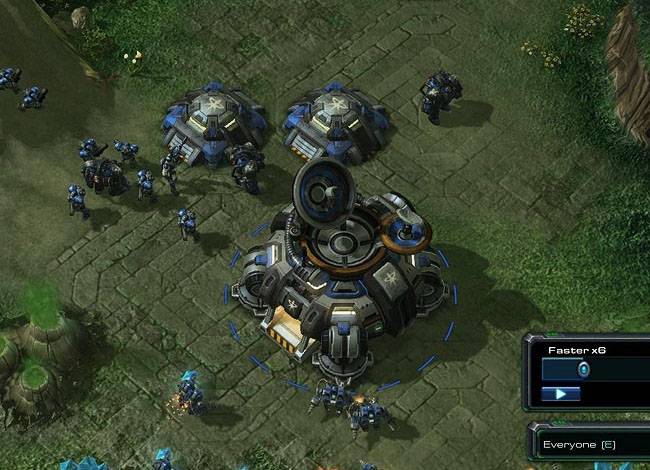
Base building placement can be meaningful as a means to block access; this could be “walling off” or creating choke points and limiting surface area to reduce the efficiency of melee units. It sounds simple but there’s a lot that needs to go into an RTS game for those mechanics to actually matter. Not only does StarCraft and WarCraft 3 have lots of melee units, but ranged units have very short attack ranges relative to their model size. A blob of stalkers getting clumped up will be much less efficient than if they were firing from a nice concave. Inversely, the infantry units in Command & Conquer (C&C) are tiny for their massive attack range so being limited by choke points doesn’t affect DPS and structures won’t be a deterrent.
Utility
The more utility buildings have, the more their placement will matter. WarCraft 3 is a fantastic example of this with quirks such as shop structures that sell items to heroes, Ancients that attack nearby units, Orc Burrows that are garrisoned by Peons, Moon Wells that replenish, Farms to shield turrets and many other examples. The art of base building in WarCraft 3 is a crucial skill and the hyper-vulnerability of structures during construction combined with open maps and no natural high ground like in StarCraft means even the timing of base building is important. C&C Generals also has good examples with the GLA Palace being both a tech structure and a garrisonable emplacement that creates a trade-off of wanting to place it somewhere safe or boosting a defensive line.
Additional Vulnerabilities
Additionally, the more ways players interact with buildings the more meaningful their placement will be. C&C is the only franchise I can think of that gives buildings more vulnerability types than just simply attacking them. From capturing them with Engineers to stealing money with Spies or blowing them up with a stealthed Colonel Burton; there’s a lot of cheeky stuff that can happen to your buildings in Generals. When placing a Super Weapon you can’t just think about is it safe from attack, you have to think about is it fully covered by detection from all angles so a scumbag Saboteur doesn’t come along and reset the countdown timer. Engineers can also be used to instantly, fully repair a structure so placing a Barracks directly behind a Command Centre or other crucial building could heavily pay off. If an RTS is made with extra bonuses and vulnerabilities to structures, then base building will naturally become more meaningful. What if Infestors in StarCraft 2 could capture a Barracks to spawn Infested Terrans, how would that affect base building?

Busy Workers
The placement of base building in Company of Heroes (CoH) is not meaningful, there’s a couple of small quirks but mostly it doesn’t matter where you plonk your structures down. CoH makes base building meaningful in a different way, rather than about specific positioning, base building is a time investment from something that actually matters. Base building in most RTS comes from worker units that are either sitting idle in base waiting (DoW1) or are collecting a resource and are ready to be pulled with little consequence, but not in CoH. Engineers aren’t cheap and have enormous utility between capturing points, repairing, building fortifications, planting/sweeping mines, and being in combat especially with a flamethrower. Every time you build a structure in CoH, it’s being done with the opportunity cost of all those engineer functions, and that adds a layer of strategy to do with retreat timings and map presence.
Vulnerable Workers
The more utility you can pack into worker units, the more meaningful their participation on the map will be and therefore the more strategic consideration goes into base building. C&C Generals also does utility on support units quite well, such as Construction Dozers used for crushing infantry which comes into play in the early game because of crushing workers to deny GLA tunnels. In general, I find slow, expensive and/or fragile worker units to be much more interesting than fast and expendable ones because then sniping workers becomes a specific type of harassment. There’s no quirky utility for the Engineers in Ashes of the Singularity, but they’re still significant as a form of harassment because of how they’re balanced and their movement speed relative to the map sizes.

Building Mechanics
As much as I love C&C I think worker units are a better mechanic than buildings magically deploying from the sky. Though C&C3 and Red Alert 3 do have some units which are analogous to worker units. Build radius is limited in those games so if you want to expand out to distant resources you’ll need to send out and deploy an Emissary/Sputnik. These build radius units are expensive, slow and fragile which opens up an opportunity to snipe them en-route. Once deployed they’re much tougher but can still be destroyed to prevent building placement in that region. It’s a cool mechanic, but sadly they’re rarely used as they’re undercut by the free ability to simply unpack the MCV and then drive it somewhere else with its massive build radius. Balance in those games aside, traditional worker units may not be suitable for an RTS but there’s still room to add depth and harassment options to base building. This can also be seen with the Empire in Red Alert 3 that use weak mobile cores that deploy into a structure.
Scouting
As base structures are generally the first step of a strategic investment, they provide the best form of scouting. Scout a Dark Shrine and you know you need detection for those incoming Dark Templar, but scout mass Gateways and you know you'll need bunkers for that all-in. When the scouting of base building matters, then scouting and counter-scouting becomes a big part of the game and helps it flow by creating small skirmishes. Players will then try to place structures in a way to obscure scouting or mislead the enemy, and even more drastic things like proxy buildings (hidden outside the main base). Scouting also needs to be designed in a way where it’s fair and not too easy or too difficult, and the significance of structures at a particular timing needs to mean something that the enemy can read. Scouting a Dark Shrine wouldn’t be useful if it also unlocked Colossus and High Templar. Going back to build times for a moment, the longer the unit build times are relative to income, the more production structures are needed. The more production structures are needed, the easier it is to scout specific strategies.

Adjacency Bonus
Like with many others of these RTS discussions, applying them to large-scale RTS games can be quite challenging. Supreme Commander takes an unconventional approach to make base building meaningful via its use of adjacency bonus. Building economy structures next to certain structures will provide a bonus such as reduced energy consumption. I don’t think this is a good approach and I wouldn’t recommend it because it’s not creative, it’s mathematical efficiency telling you the exact way you should be placing structures. In theory, it’s offset by the volatility of Power Plants but that hardly matters in a real match. Adjacency bonus to that style would be a better mechanic if there were meaningful trade-offs between different types of bonuses you have to weigh up. Mutually exclusive adjacency bonus is a way to think about the Tech Labs and Reactors for Terran buildings in StarCraft 2. Those add-ons are especially a great mechanic that adds incredible depth because of how Terran buildings can lift off to swap between the two add-ons.
Summary
In summary, most RTS players tend to enjoy base building just for the sake of it, but it can be way more fun and provide an avenue for immense strategic depth if the specific positioning of structures has consequences. The game’s economy will heavily tie into the importance of structure placement, but base building can be meaningful through many other ways. Structures can be used to block pathing or funnel troops, so long as the game is designed where clumping limits DPS. If buildings have additional utility and vulnerabilities then interaction types are created which naturally gives their positioning benefits and consequences. The timing of base building can be made more strategic if builder units have additional utility as that creates an opportunity cost to having them idle in the base. Otherwise builder units should be a combination of slow, expensive or vulnerable to provide harassment targets. Lastly, an RTS should be designed in a way so that base building reveals strategic information to create the dynamic of scouting and counter-scouting, which encourages players to hide important tech buildings and creates small skirmishes.

 Stardock Forums
 Sins Forums