Our Sun is throwing a Tantrum - UPDATE - Huge X6.9

http://spaceweather.com/

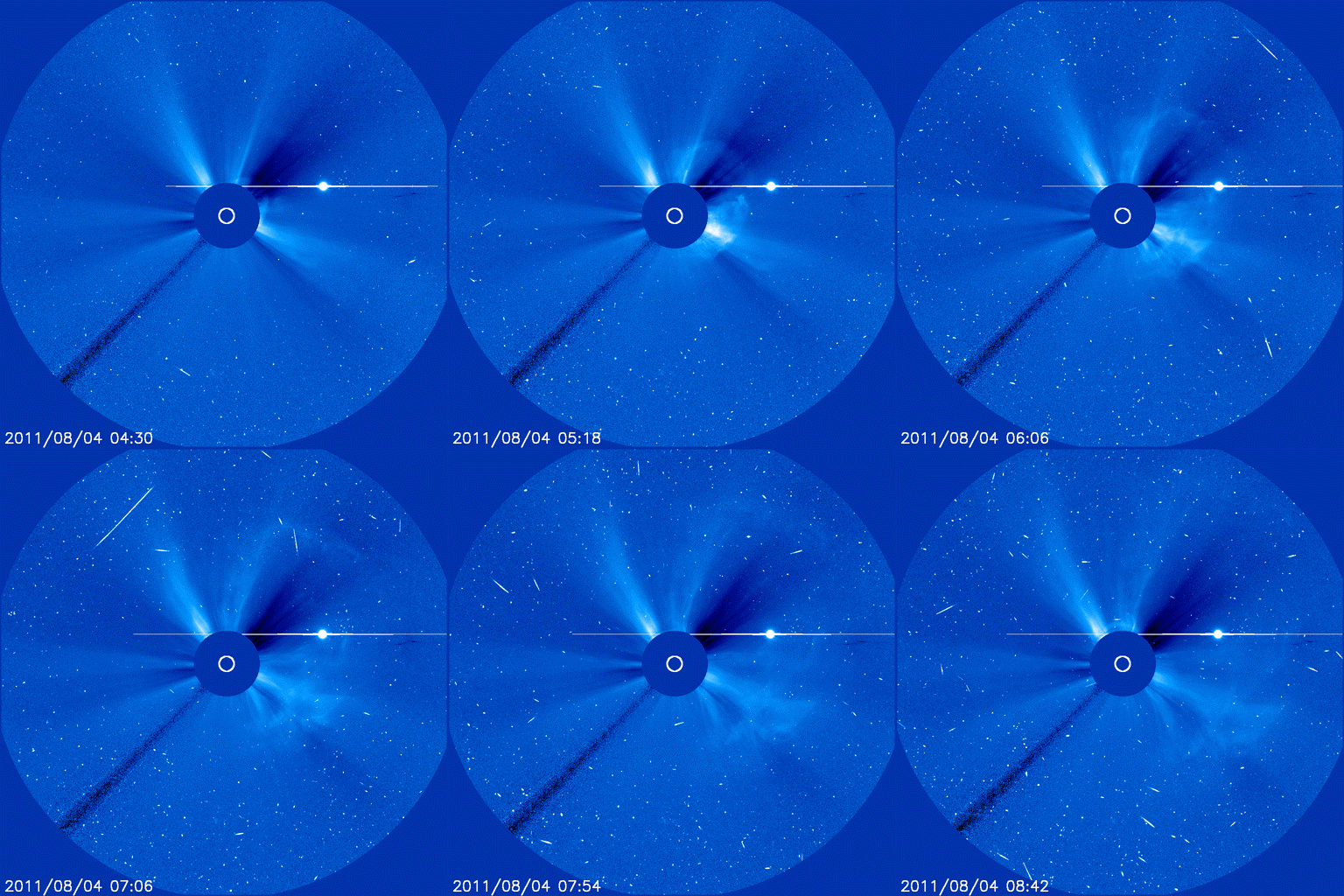
STRONG SOLAR ACTIVITY: On August 4th, active sunspot 1261 unleashed a strong solar flare, the third in as many days. The blast, which registered M9.3 on the Richter Scale of Flares, hurled a bright coronal mass ejection (CME) almost directly toward Earth. 

Moving at an estimated speed of 1950 km/s, this CME is expected to sweep up an earlier CME already en route. Analysts at the GSFC Space Weather Lab say the combined-CME should reach Earth on August 5th at 10:00 UT plus or minus 7 hours: "The impact on Earth is likely to be major. The estimated maximum geomagnetic activity index level Kp is 7 (Kp ranges from 0 - 9). The flanks of the CME may also impact STEREO A, Mars and Mercury/MESSENGER." High-latitude sky watchers should be alert for auroras.
http://spaceweather.com/


from March 2009 

No wonder everyone is dumping their stocks.  ;P
Not to worry though, it's only a very big "M" and not an "X".

http://science.nasa.gov/heliophysics/big-questions/how-does-solar-variability-affect-human-society-technological-systems-and-the-habitability-of-planets/

http://www.nasa.gov/mission_pages/sunearth/news/News080411-dblpunch.html

111,655 views 21 replies
Reply #1 Top

At present, even if we know for sure that a CME plasma cloud is directed towards Earth some days ahead, the effects on power grids, satellites, etc, depend upon the relative orientation (polarity) of the magnetic fields of the plasma and Earth. Under certain alignments, even the most intense plasma disturbance will pass earth with virtually no effect whereas, under others, the threat is real and potentially disastrous. Intermediate levels of danger depend upon the relative polarity of Earth and plasma magnetic fields between these two extremes.

Critically, the only source of information on the alignment of the magnetic fields is NASA’s Advanced Composition Explorer (ACE) satellite and, therefore, the only system able to provide advanced warning of geomagnetic storms. Given the position of ACE in space between the Earth and Sun (L1 point), however, only short term advance notice (1 hour at most) is possible.
http://www.washingtonpost.com/blogs/capital-weather-gang/post/space-weather-basic-information-for-understanding-solar-strike-risk/2011/06/21/AGoz4beH_blog.html 


Reply #2 Top
Wait...you watch Fox?
Reply #3 Top

Quoting Sinperium, reply 2
Wait...you watch Fox?

Na, I just typed Dr Kaku in YouTube because I remember him explaining this in one of my science magazines. 

Reply #4 Top

Quoting myfist0, reply 3
Na, I just typed Dr Kaku in YouTube because I remember him explaining this in one of my science magazines.

He's the new Carl Sagan. ;)

Reply #5 Top

Quoting Sinperium, reply 2
Wait...you watch Fox?

Who cares about this ultimate solar flare? If myfist watches Fox the world is truly over. :P

Reply #6 Top

My computer is still working, so no go on the end of the world.

Quoting GoaFan77, reply 5

Quoting Sinperium, reply 2Wait...you watch Fox?

Who cares about this ultimate solar flare? If myfist watches Fox the world is truly over.

Tasteless?

Reply #7 Top

Tasteless?  Nah.  Irony is delicious.  XD

Reply #8 Top

Quoting GoaFan77, reply 5
Who cares about this ultimate solar flare? If myfist watches Fox the world is truly over.
Pretty much what I thought, too. 


:fox:

Reply #9 Top

Damn it, the lights are still on. >:(

And I had picked out my best barbarian loin cloth.

Reply #10 Top

Don't feel bad. What you saw is known as a worst case scenario. And there have been one or two incidents in the past with power being disrupted by solar flares. But mostly they just make pretty lights.

Reply #11 Top

well, the sun is scheduled to go hit it's maximum soon. I believe it has 11 year cycles, and we just had a minimum. However, the minimum has lasted longer than usual, leading some to predict no maximum this time (or so quiet that you wouldnt call it a maximum). They point to "the little iceage" some time ago as evidence that there is another periodicity to the cycles.

The hope is that if the sun maintains it's cool, it might negate global warming affects. However, even during minimums theres always a few bigguns'.

And I personally don't like Kaku... or really any of the "treat the camera like it's a child who doesnt know anything"-style scientists. I prefer actual details, not oversimplified analogies.

Reply #12 Top

Quoting SithLordAJ, reply 11
And I personally don't like Kaku... or really any of the "treat the camera like it's a child who doesnt know anything"-style scientists. I prefer actual details, not oversimplified analogies.

I can totally agree with that but most people would not get past the first paragraph if they were reading Steven Hawking. Flip back to the comic section or the topless girl on page 3 or who is dating the latest pop star. We have a generation of people who get their education from the Simpsons and MTV. Maybe would should integrate education into video games?

Reply #13 Top

SLAJ & myfist0 -

Your exposure to Kaku has doubtless been in mass media, where it is beneficial to utilize analogies to help non-scientists (and possible future scientists) grasp the gist of complicated concepts.  He does that well, in an engaging manner.

Were you students in one of his classes, on the other hand, I expect the experience would be... tolerable, even for folks as intelligent as the two of you. ;)

Reply #14 Top

Quoting SithLordAJ, reply 11
well, the sun is scheduled to go hit it's maximum soon. I believe it has 11 year cycles, and we just had a minimum. However, the minimum has lasted longer than usual, leading some to predict no maximum this time (or so quiet that you wouldnt call it a maximum). They point to "the little iceage" some time ago as evidence that there is another periodicity to the cycles...

Well, there is some other cycles, some not directly related to the sun...

The 11 year cycles have is a well know one... but your have a 20k year cycle, due to the axial precession of the earth... can be see in the insulation curve in the link to a graph below ( 420k year data from ice core ) :

http://en.wikipedia.org/wiki/File:Vostok_420ky_4curves_insolation.jpg

The 100k cycle is related to the precession of the ecliptic... drift up and down from earth orbit...

There is a 400k cycle who can be found in sedimentary record... somehow related to the eccentricity variations from the earth orbit around the sun...

Reply #15 Top

Quoting myfist0, reply 9
Damn it, the lights are still on.

And I had picked out my best barbarian loin cloth.

Sorry Myfist - faux chinchilla just does not work in summer! ;)

Reply #17 Top

Quoting Daiwa, reply 13
SLAJ & myfist0 -

Your exposure to Kaku has doubtless been in mass media, where it is beneficial to utilize analogies to help non-scientists (and possible future scientists) grasp the gist of complicated concepts.  He does that well, in an engaging manner.

Were you students in one of his classes, on the other hand, I expect the experience would be... tolerable, even for folks as intelligent as the two of you.

If by 'mass media' you mean the pbs shows that all of 10 people watch, yes. Maybe I am being judgemental, but that guy has an attitude like he would talk that way to another scientist in the same field. Look, heres the thing: The people who actually do watch the science shows do not need to be babied that way. They are watching the show to learn something. You cant actually learn anything with an analogy; the best you can do is be correctly ignorant of the subject.

Now, when he/they go on news shows as an advisor that is talking to the general populace.... I wouldnt be too annoyed if I wasn't instantly annoyed by his presence at this point. And even then, you owe it to the people that are in the know to give the details after you have made the simple speech.

Reply #18 Top

Analogies are useful introductions to concepts.  I'd like to think (but have no evidence confirming) that he goes beyond introductory analogies with his students, and dispenses with them when addressing fellow academics and others 'in the know'.  You and I might like greater 'substance' in such programs (PBS, Science Channel) but that's not really a fair condemnation of programs aimed at a mass audience.  Nothing about anything he's done on those shows leads me to believe he has an 'attitude' toward other scientists.  Then again, scientists at the top of rarified disciplines all have an ego... just like any good surgeon.  0.02

Reply #19 Top

Well, as I said, I could be wrong. I dont know. He just annoys me, and theres no getting around that. Also, I dont see how an analogy, in and of itself, can be at all useful. All you're doing is defining words in terms of other words, which is completely pointless. Yes, you can teach someone via an analogy; You tell them the analogy, and then point out every flaw in the analogy. Most things, however, are not like anything else (in this context). ie A Blue Jay looks like a Robin, except it's smaller and stouter. Also, its belly is white and it's back is blue. Finally, it has a little crest around it's head and a short, black beak. Kaku does not point out the flaws in his analogies.

I'm not sure you caught a point of mine, and a wish to re-iterate it: People who turn to pbs, science channel, discovery, or national geographic (as lately im finding the best stuff there), turn to that because they want to learn more about those things they already like. So, it is my opinion that any person in any of those shows should address the audience as if they have heard, for example, of 'black holes' before. If I decide to turn on a show about black holes, I have some idea of what they are.

Now, im not suggesting every program be graduate-level physics... but when was the last time you happened apon one that was? It's all idiot-level programming, and it shouldnt be that way. If you assume that the audience came into the show with some knowledge of the subject, you can get alot further. If someone happens on the show and doesn't know what a black hole is, I'm confident they can figure it out. If they can't, that person probably wouldn't be interested in the program if they did know.

And to be clear about Kaku's 'attitude': I dont mean he's purposefully condescending. I'm sure he doesnt know he's annoying in this regard. It's just the way he talks, and so I see him talking that way to everyone.

Reply #20 Top

I'm not so sure it's fair to call what's out there 'all idiot-level' simply because you haven't happened upon 'graduate level physics' on TV, though it got the label 'idiot box' for some reason I suppose.  ;)

I think you're expecting something for which the 'market' is too small.  It would be great if such programming were available, but I suspect it would need to be pay-per-view to make it, and I doubt it would then.  Not cheap to make those shows (and pay Kaku :grin: ).  Whether we like it or not, television is limited by the need to draw advertisers to a broader audience.

Reply #21 Top

I can say that Tv is a great source of science and physics education. Take Jackass for example, it teaches me that:

Dumbass+Gravity=good entertainment/pain

-or-

Dumbass+alcohol+lack of consideration for other people=Equals man wearing a skirt with no underwear running down the middle of an active city street.

MyFist0 just got schooled ;)