DrJBHL DrJBHL

Last IPv4 Addresses Sold: What Now?

Last IPv4 Addresses Sold: What Now?


In the news this past week was an article notifying on the last block of IPv4 addresses having been sold in Florida.

What does that mean?

Well, it means that for ISP’s, mobile and home users the transition to IPv6 has become fairly imminent.

When the Internet was born, a mistake was made by the designers, pretty much like the mistake that led to the wave of fear about the 2K bug.

This time, the fault was a lack of imagination in seeing how huge the Internet would become and continue to expand. So, a new protocol was written called IPv6. The problem is that these new addresses won’t be accessible to IPv4 users. Consequently, a lot of changes will arrive in coming days, months, and years.

IPv4 addresses are 32-bit numbers, meaning that there are 4.3 billion possible addresses (232). IPv6 addresses are 128-bit numbers (2128 ), meaning that the number of possible addresses is vastly larger.

What does this mean for me?:

For now, you don’t have a lot to worry about. If your router is dual stacked, you can sit back and relax because if your computer has an OS of XPSP3 or later, you’re covered. It will mean equipment upgrades at the ISP level and higher will be necessary. That’ll raise costs to you as well.

In fact, a group of 25 folks in Denver, CO have been given dual stacked routers from Comcast very recently to see how that solution will work. These will solve problems without “tunneling” software. You’ll be seeing more of this in the future.

79,138 views 48 replies
Reply #26 Top

I actually heard someone lecture on this quite a while back and also heard some press releases that there are those that have been working on it. I just don't know to what level.

But, I look at it this way: One of two things will happen. The net goes on happily beyond my lifetime and I am dead, thus don't care or it comes to an end within my lifetime and I survive much the same way I did before I started surfing the net.

Goodbye to you all if I don't get a chance to say so.

Reply #27 Top

C'mon people, I accept that if we produce nanites on such a grand scale that we can fill the entire surface of the planet so that every part is obscured and stack them to unbelieveable height we *might* run someday out of IP addresses in IPv6. In that particular case it might be tho only hope for mankind to survive the onslaught of the nanites O:)


Other than that, just, please, for the sake of your intellect, inform yourself, start calculating (not using a calculator, but your computer using a scientific program) and print the number of different IP addresses onto a paper. And then think about how you could in any meaningful way spend all those addresses in the lifetime this tech is probably to live (be it even a thousand years)

You'll be amazed how impossible this really is.

Reply #28 Top

You'll be amazed how impossible this really is.
End of quote

I'd be amazed. Nothing is impossible:

FAQ's about IPv6: http://www.isoc.org/internet/issues/ipv6_faq.shtml

http://gcn.com/articles/2010/08/02/update1-ipv4-dries-up-ipv6-on-deck.aspx

There are unused blocks in various hands (see prior replies) however, they are not yet for sale. IPv4 has 4 billion possible addresses. There are more people alive than that. IPv6 has 340 Undecillion addresses. Internet usage is exploding with computer and nobile device usage. Since there is a finite number of addresses, a larger supply had to be created: Hence, IPv6. You aren't require to believe it. It's fact.

Reply #29 Top

Quoting Jafo, reply 14
We'll never need more than 640k ram ....
End of Jafo's quote

My favorite is - "No one needs to run more than one program at a time!".

famous last words by one network engineer back in 94 - ME. ;)

Reply #30 Top

IPv6 has 340 undecillion potential addresses.  But that is divided up.  There are 18 quintillion networks each with 18 quintillion host addresses.  Beginning to see some of the waste?  That means every house has a potential for that many address that are different from every other house/business/office/organization/government.

Now 18 quintillion networks is MORE than enough for the planet today.  But not all of them are usable.  The IANA has reserved large blocks of addresses (like the old 10.x.x.x, 172.16.x.x-172.31.x.x, 169.254.x.x, 192.168.x.x, and 224.x.x.x-) for special purposes.  So there are not really 18 quintillion networks.  MIT just asked for - and was given, a /30 network address.  That gives them 17 BILLION networks all for their 5000 students.  Other universities are doing the same thing.

Also, when you connect 2 routers together, you have to assign the cable between them a unique network address.  Only 2 devices (hosts) will be on that network, but it does require a network all to itself.  So 18 quintillion addresses just got wasted.

That is the waste I am talking about.  And it will eventually cause the shortage of IPv6 addresses, even before we cover the planet with nannites.  But like IPv4, they will then start pulling some of the Networks back from the "fat boys" (like MIT), and they will go ahead and figure out how to make routers do greater than /64 subnetting for IPv6 so that there is no waste of 18 quintillion addresses just to hook 2 routers together..  The reason they have not done so from the outset is that the Internet Routers just are not capable of handling 18 quintillion routes, much less more than that NOW.  But they will be in 30 (or 40, 50 or more) years when it becomes necessary.

Reply #31 Top

Since there is a finite number of addresses, a larger supply had to be created: Hence, IPv6. You aren't require to believe it. It's fact.
End of quote

Never said anything against this, quite the opposite. But using up the IPv6 address pool is an altogether different story, even with the waste.

@Dr Guy
Got a link to the claim the the MIT got 1/30th of the IPv6 address range? Just for interest

Reply #33 Top

@DrJBHL

Interesting links, though nothing here says anything about MIT getting 1/30 of the IPv6 address range

Reply #34 Top

I didn't say they got 1/30. They only got a paltry 16,777,216 addresses.  :\

Reply #35 Top

Quoting TobiWahn_Kenobi, reply 31


@Dr Guy
Got a link to the claim the the MIT got 1/30th of the IPv6 address range? Just for interest
End of TobiWahn_Kenobi's quote

Not 1/30th (that would be obscene!).  A "slash" 30 which means their network address only contains 30 bits, and then they have 34 bits of subnets to work with.  Sorry, I should have been clearer on the nomenclature.

Quoting DrJBHL, reply 34
I didn't say they got 1/30. They only got a paltry 16,777,216 addresses. 
End of DrJBHL's quote

of IPv4 (that would be a class A).

Reply #36 Top

Quoting Dr, reply 35

Quoting DrJBHL, reply 34I didn't say they got 1/30. They only got a paltry 16,777,216 addresses. 
of IPv4 (that would be a class A).
End of Dr's quote

Correct.

Reply #37 Top

@Dr Guy

Ok, I was stunned how someone could request 1/30th of the IPv6 address space, thanks for clearing up my misunderstanding.

Reply #38 Top

Quoting Uvah, reply 5
In thirty years? Nah ....... it'll be too scary.
End of Uvah's quote

Heh, I'm hoping in 30 years we'll all be "jacking in" Matrix style :)..LoL I wish.

Reply #39 Top

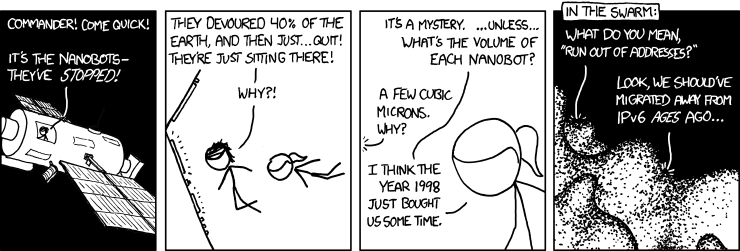
There was funny comic of nanomachines running out of IPV6 addresses when they ate only 1/4 of earth.


Couldn't find it again so... drat. :P

Reply #40 Top

Quoting XX, reply 39
There was funny comic of nanomachines running out of IPV6 addresses when they ate only 1/4 of earth.


Couldn't find it again so... drat.
End of XX's quote

It was in one of my threads, if that helps...


Quoting RavenX, reply 38

Quoting Uvah, reply 5In thirty years? Nah ....... it'll be too scary.

Heh, I'm hoping in 30 years we'll all be "jacking in" Matrix style ..LoL I wish.
End of RavenX's quote

Reply #41 Top

Stay tuned for quantum computed addressing with an infinite number of addresses ;)

Reply #42 Top

Quoting XX, reply 39
There was funny comic of nanomachines running out of IPV6 addresses when they ate only 1/4 of earth.


Couldn't find it again so... drat.
End of XX's quote

That would probably be the XKCD from last friday.

Reply #43 Top

Reply #44 Top

Quoting XX, reply 39
There was funny comic of nanomachines running out of IPV6 addresses when they ate only 1/4 of earth.
End of XX's quote

And thanks to awuffleablehedgie for posting it!  That is a riot!  :grin:

And while they may not be devouring the earth, who knows where in space they will be working!

Reply #45 Top

Indeed. Thanks! :D

Reply #46 Top
Hi, Rolf ....;)
Reply #47 Top

Hey jafo :)

Reply #48 Top

having that many IP addresses does have interesting security implications. Especially when the invader does not know to use an ipv6 anonymous.... otherwise your MAC is wide open for everyone to see!!


Let me illustrate;

you scan a network... somewhere in that massive IP range is a server. Its gonna take months to get anywhere. In the mean time they see you scanning and read the MAC in your IPv6 default IP address. This ties your hardware to the IP specifically. So it is fairly traceable through the ISP. 

On the other hand if the hacker uses whats called an anonymous IPv6 address no mac is viewable.

Somebody has already been caught scanning in this way.