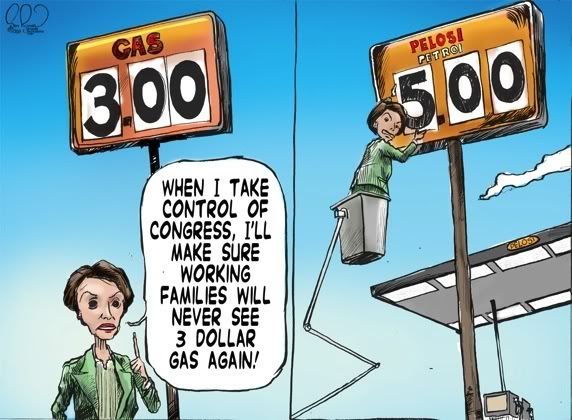
Pelosi Shows Why Democrats Just Don't Get It

Pelosi is the perfect example of how democrats just don't get it when it comes to oil and energy.  This coming from the woman who demanded a bigger plane for her travel.

“Making gasoline more affordable would be the exact opposite of what we need to do,” Pelosi asserted. “We need to wean the country off of its dependence on fossil fuels. We can only do this if we discourage Americans’ love affair with their cars and put an end to the frenzy of excessive and senseless driving.”

She also keeps complaining that Bush will open the oil reserves so she can get her 3 days worth of oil, but opening up our resources is wrong.  She has a pair big enough to tell Americans they should end their "love affair" with cars, but yet demand she gets a bigger jet for her use.


13,050 views 45 replies
Reply #1 Top

Yep, in a perfect world we could all ride our bikes to work, take the bus or carpool but this isn't the perfect world.  What happens to the economy when people can't afford to drive to work anymore?  What happens when only the richest Americans can travel by plane?  And exactly what alternative energy sources are they developing?  We are now seeing the results of the wonders of ethanol, less efficient fuel, higher food prices, food shortages in other countries.  I care about the environment but I want to be able to turn the lights on when its dark and I want to be able to afford to put gasoline in my car. 

If John McCain were smart he would hammer away on this issue.  He could win the election on energy policy alone. 

Reply #2 Top

Island Dog-

Actually, I agree that Pelosi doesn't get it. Neither does Bush however! In this case, both parties are dead wrong on what should be done.

Pelosi calls for conservation and cutting back, which although admirable, doesn't address the root cause.

Bush calls for increasing oil production, which will also temporarily alleviate the situation but also doesn't address the root cause.

Neither of these sides touch on the fact that we need to get off of gasoline altogether with massive alternative energy initiatives. Pelosi's solution is to live in cold houses and ride bikes, which although will cut back resource consumption doesn't actually fix anything and only prolongs the inevitable.

Bush wants to open up the remaining untapped reserves in north America to alleviate current high prices, but that will only tide things over for a few years at best. Meanwhile he has absolutely no plan for what to do after that, at which point you'll really be up the creek without a paddle if alternative solutions haven't been implemented!

So both sides offer bandaid solutions because no one wants to stick their neck out, exercise real leadership and admit that our current lifestyle is supported by obsolete, inefficient machines that guzzle way too much energy!

Reply #3 Top

Everuthing (oil, nuclear, solar, wind, etc.) is going to take time. What these people fail to realize is you must start now! The silliest thing I've heard is not to drill because it won't do anything immediately....like waiting will.

Reply #4 Top
Neither of these sides touch on the fact that we need to get off of gasoline altogether with massive alternative energy initiatives. Pelosi's solution is to live in cold houses and ride bikes, which although will cut back resource consumption doesn't actually fix anything and only prolongs the inevitable.
End of quote


What you write here is true. The problem is that as long as you have people that want to “save” the planet you will have people doing what is against the best interests of the people and the nation. To get votes the liberals embrace idiots because sane people won’t vote for them in large enough numbers. The liberal play book demands they not fix anything in order to get votes from the people that demand a fix. Once it is fixed they know that people will not care about them so they need problems to blame on anyone and band aids to make it look like they are fixing the problem.

Bush wants to open up the remaining untapped reserves in north America to alleviate current high prices, but that will only tide things over for a few years at best. Meanwhile he has absolutely no plan for what to do after that, at which point you'll really be up the creek without a paddle if alternative solutions haven't been implemented!
End of quote


Here I disagree with you to a small extent. You are correct it does not provide a long term solution to the problem but it was never supposed to be. Remember the saying that necessity is the mother of invention?

As long as we have oil and know that the price is artificially high we won’t have any serious breakthroughs in technology. Oil is the cheapest way to run an economy. When that is used up in 200 years (the estimated reserves within our borders) we will have come up with another solution to the problem. There is more oil off the coast of California than there is in all of Texas. There is more oil off the coast of Florida than in Texas. There is about as much all as Texas in North Dakota. None of it has been tapped for environmental reasons.

I see what you are saying that we could run out of oil before we get a fix but that is pessimism. We invented the airplane and went to the moon in the same century. The inventions we had to come up with to get to the moon are the technologies we are using today. It was NASA that came up with the hydrogen fuel cell. NASA caused the improvements that made solar power cells a viable option for us to use. The atom bomb was conceived when they figured out what would happen if a nuclear power plant had an oops. Yes, the bomb created devastation but what we learned from it made our power plants safe. Nuclear power plants have been around since the 1930’s but we can’t build them because some idiots scream that they are unsafe. Even the idiot Soviets that have had more nuclear accidents and disasters than you can count had to disengage all the safety systems in order to have one of their badly designed power plants blow up. The worse nuclear accident in America cost the lives of 12 people back in the 1950’s how many Americans have died in oil refinery fires in that time? Hundreds.

We had to get to the moon so we did. Along the way we invented things like the MRI, Cat scans, solar power, hydrogen fuel cells, WD-40, and a host of other minor inventions. During WWII fuel was a problem so we invented flex fuel vehicles. These things ran on newspaper, coal oil, coal, anything that burned. When we had enough gasoline flex fueled vehicles got put into the closet and when fuel became expensive we dragged them out and upgraded them.
Both America and Nazi Germany came up with synthetic fuel. Too expensive to be useful at the time but it was invented out of the need to fuel their machines. Along the way we have fixed and improved out fuel usage. Given more time we will do better. There is no need to punish a nation or the world with draconian conservation measures when we can just allow our engineers and scientists work on the problem as they have in the past and are doing today. The solution is not here and won’t be for decades but we are working on it. To buy time we drill, use it all up because when we stop using oil we will have to expend a huge amount of money to clean up the seepage from the earth of oil.

My point is that the President is doing the right thing for the right reasons. He is being oppsed for political reasons not because it was a bad idea. This is not a band-aid it is a stop gap.
Reply #5 Top

Well, it certainly is good that we can agree on something! However on one point I'm going to have to diverge-

Oil is the cheapest way to run an economy. When that is used up in 200 years (the estimated reserves within our borders) we will have come up with another solution to the problem. There is more oil off the coast of California than there is in all of Texas. There is more oil off the coast of Florida than in Texas. There is about as much all as Texas in North Dakota. None of it has been tapped for environmental reasons.
End of quote

There is currently not 200 years of reserves in the U.S. Currently you have about 3 years worth inside your borders. The U.S currently has 21 billion barrels (approx) proven reserves. As 21 million bpd consumption, your current rate, you would burn through that in 3 years. The other kicker is this-

Since 1970, U.S domestic production has been declining. That's 38 years of falling levels of production. Currently only 37 percent of your oil is produced domestically with over 63 % being imported. Even if you managed to increase your domestic production to 50 % of what you need (more than 10.5 million barrels per day which would surpass the height of U.S production in 1970) you would still be beholden to foreign oil and a major overseas war or disruption of that supply could easily make gas a commodity so expensive that only the state and industry could afford it with average folks riding bikes!

All of this information is easily obtained from geological society reports and the like!

Regardless, we need a solution that looks forward to new way of doing things. You're absolutely right about all the wonderful inventions we've created. Now it's time to get off the oil!

Reply #6 Top
Actually, I agree that Pelosi doesn't get it. Neither does Bush however! In this case, both parties are dead wrong on what should be done.
End of quote


I think iti s more pandering than not getting it - on both parts.

While your solution is a nice long term one, it does not address the here and now. Your solution is the very long term one. Bush is the long term one, and Pelosi is the short sightedness one.

We cannot go from a petroleum economy to an alternate fuels one over night. It will take time. A lot more time than it will take to bring proven reserves on line and alleviate the short term issue (supply). IN the interim, we have nothing.

But where all of them, and even you, are jumping up and down and demanding "something" be done (different somethings), the simple elegant truth is that something already is. We just wont see it for awhile (no one saw WWII coming until it came - but there was a lot of signs in retrospect).

Step one, make alternatives economically feasible. OPEC did that (although they did not intend to - they were just milking the cow).

Step two, keep prices up to ensure that the alternatives can be tested and improved (version 1 not only sucks in software, it does in almost everything). Entrepreneurs learned that lesson in the 70s when it spiked - they are not going to be burned again. This is being done by the mere inaction of the politicians (doing the right thing for the wrong reasons).

Step Three, convert.

Step 2 has 2-3 more years to go. Step 3 is about 10-15 years away. Once the world is use to and does not expect prices to come down (and that will give a false sense of security to OPEC), then the alternatives will start to pan out. Shaky at first, but always a backyard tinkerer to improve it - and it will be.

Pelosi is just showing her stupidity and hypocracy. She wants higher prices, but she also wants you to think she cares about you. I think this demonstrates she only cares about higher prices, and not the individual. Lip service is easy, and right now the only thing the "feeling" idiots in congress can do.
Reply #7 Top

Regardless, we need a solution that looks forward to new way of doing things. You're absolutely right about all the wonderful inventions we've created. Now it's time to get off the oil!
End of quote

That sounds nice, but reality is, we aren't getting off oil anytime soon.  Even if we started now it would take decades to get independence.  The short term solution is drilling for our own resources, while at the same time working on the bigger problem.


Reply #8 Top
There is currently not 200 years of reserves in the U.S. Currently you have about 3 years worth inside your borders. The U.S currently has 21 billion barrels (approx) proven reserves. As 21 million bpd consumption, your current rate, you would burn through that in 3 years. The other kicker is this-
End of quote


Proven reserves are fields we are currently using or are brining on line. Not the oil that we know to be in the ground but have not tapped. The oil off the coast of California is a proven reserve but we are forbidden to drill for it so it comes off the table and out of the statistics. China is currently drilling for oil off the coast of Cuba/Florida. They estimate a ten year supply of oil just from there. it is what they can get without going into our territorial waters.

Since 1970, U.S domestic production has been declining. That's 38 years of falling levels of production. Currently only 37 percent of your oil is produced domestically with over 63 % being imported.
End of quote


This is our own legislative doing. Our laws currently put a windfall profits tax on domestically produced oil making it cheaper to buy it from others. This has caused oil companies to cap wells to save money but even now they are starting to bring them back on line but they were capped because they were low producers not because they were restricting the oil.

The other issue is that we don’t have the refining capacity needed to refine more oil. Since the 80’s we have had to import gasoline as well as crude oil. In the 70’s the oil executives told my Congress that they needed to build more refineries and more nuclear reactors. The Congress at the time did not believe them and imposed heavy restrictions on building more refineries and nuclear power plants. The paper work needed to get approval to build a refinery takes about 10 years if no where along the way anyone puts up a legal challenge. Environmentalists have put up challenge after challenge every time one was proposed. 30 years without a new refinery with increasing demand has put the plants at 90 to 110% of rated capacity.

Add to that the local laws that demand the fuel mixture include or exclude different chemicals and additives like ethanol. Currently there are 56 different blends that are mandated by law that have to be made in three categories of premium, midrange and regular gas and on top of that they have to make a summer and winter blend of the 56 blends. This eats up a lot of refining and storage space.

Get rid of the 56 blends and bring it down to 3 and we have more fuel, get rid of the mandate of a midrange fuel and you have more gas. Get rid of the windfall profits tax of the 70’s and you have more domestic fuel.

Allow the oil companies to drill where we know there is oil and our reserves increase. All of that will bring down the price of gas.

Build more nuclear power plants and you rely less on oil fired power plants also bringing more fuel to the party. Wind power is a great help but not the answer alone the same with solar power. Both of them are more expensive but as we learn more we refine and tweak the technologies becoming more efficient as we go.

America legislated ourselves into this mess and we are almost to the point where legislation will not help get us out of it. China and India are the reason we have this spike in oil prices. Their massive growth was not anticipated and we were caught flat footed. There is also a world wide shortage of cement for the same reason. So it is not just oil that has gone up in price.

Even if you managed to increase your domestic production to 50 % of what you need (more than 10.5 million barrels per day which would surpass the height of U.S production in 1970) you would still be beholden to foreign oil and a major overseas war or disruption of that supply could easily make gas a commodity so expensive that only the state and industry could afford it with average folks riding bikes!
End of quote


To get that much oil all we need to do is start drilling off the coasts of California and Florida. The problem is it will take 15 years to get the refining capacity to handle it all without having to import refined product.
Reply #9 Top
The short term solution is drilling for our own resources, while at the same time working on the bigger problem
End of quote


I agree with the above statement. However I have seen nothing from Bush on working on the bigger problem, instead he is simply trying to maintain the status quo. IF he were to say "we need to increase domestic production now while we work on a real plan to get off the oil soon!" it would be a different story entirely. Instead his solution is simply to increase the rate at which a finite resource is going to be extracted, thereby shortening the length of time that we will have to use that resource with no plan for what to do after that. This is a guy who tried to push "clean coal" as a long term viable solution. As soon as his term in office is up which will be very soon, he's off to his ranch in Paraguay where he will undoubtedly laugh at the plight of the average American from his Blackwater Inc. guarded estate!

As for taking years to get off oil you're also correct that it won't happen anytime soon, but in switching to alternatives that are available now we can drastically reduce our demand and consumption for oil and eventually phase it out. If for example, in two years time there are economically viable electric cars on the market (in the range of 30 thousand dollars or so, which is realistic as GM plans to do this) anyone looking to buy a new car will probably choose electric over gas. Sure, it's not like everyone decides to buy a new car right away but most folks have a car on average for 10-15 years. So doing some quick and very dirty math, we could maybe say that over the space of 2 years at least 10 % of the car owners will look to replace, no?

So that right there would be 10% of the vehicles on the road no longer requiring gas to run, drastically reducing demand. Over a five year span, coupled with the high cost of gas creating an incentive to switch, we could hit, what, 25-30% of the cars on the road replaced?

Of course this would assume manufacturing capacity could meet it, but right now GM and Ford have plenty of capacity but no one's buying. Retool idle factories to build electrics instead of internal combustion, everyone wins and can enjoy chicken on sunday. The end.
Reply #10 Top
I agree with the above statement. However I have seen nothing from Bush on working on the bigger problem, instead he is simply trying to maintain the status quo.
End of quote


That is not the president’s purview. Government is not supposed to provide the solution they are just supposed to give us a free hand to make the discoveries. I understand you better now. You expect the government to rush in and save the day. Government does not work that way. When the government tries to do something it is usually in the most inefficient manner. Going to the moon they went to contractors and said build this or that. They left it up to business to find the best way to do it. When the Government tried to design the space shuttle they had pet businesses in mind. Hence the rocket boosters needed to lift the thing off the ground. Let business find a way to make money and they will do it.

but in switching to alternatives that are available now we can drastically reduce our demand and consumption for oil and eventually phase it out.
End of quote


Please list the alternative fuels that are available.

If for example, in two years time there are economically viable electric cars on the market (in the range of 30 thousand dollars or so, which is realistic as GM plans to do this) anyone looking to buy a new car will probably choose electric over gas. Sure, it's not like everyone decides to buy a new car right away but most folks have a car on average for 10-15 years.
End of quote


This is all based on your supposition that within two years we will have these vehicles in the market. You do know that the average time it takes to go from drawing board to the show room is five to seven years. So if they started today the car would not be in the show room before 2013. Saturn has the fastest time to show room at three years. Japan takes seven years to get a car to show room unless they do what they did in the 80’s which was to use 10 year old models and up grade them then they can put a new car out in four years.

Hybrids are okay for the short term if they can get the price down. And get the environmentalists to keep quiet. Remember that the batteries used in them cause so much pollution to make that gasoline only vehicles are less damaging to the environment.

Electric only vehicles have come of age and the expensive ones can run at 130 miles an hour and hold their charge for about 100 miles. The ones that are affordable only have a range of 40 miles. Great for local driving but not much else.

This is a guy who tried to push "clean coal" as a long term viable solution.
End of quote


Clean coal is a good solution since we have millions of tons of it and turning it into fuel costs about 25 dollars a barrel.

As soon as his term in office is up which will be very soon, he's off to his ranch in Paraguay where he will undoubtedly laugh at the plight of the average American from his Blackwater Inc. guarded estate!
End of quote


That is a cruel and uninformed statement. I am assuming you don’t know that his property is zeroscaped that he uses reclaimed water on his ranch, solar power cells on his roof to heat the house and water and all of that was years before he became Governor of Texas. His electrical usage is a quarter of what the average house uses. While Mr. Gore, the great environmentalist, uses enough electricity per month to power 120 homes.

With all of this being public knowledge, the person you choose to ridicule is the one trying to do what is best for the nation? The man was in the oil industry and knows how it works and what will and won’t work.
Reply #11 Top

I have seen nothing from Bush on working on the bigger problem, instead he is simply trying to maintain the status quo.
End of quote


Congress is more of the problem here than Bush.  Why not go back and blame Clinton too, he didn't do anything either.

Reply #12 Top

Oil is not just about gasoline or fuels. Oil is being used in plastic, petro chemicals, polymers, asphalt, etc. Demand for these products is rising at huge rates. To think that anyone on the planet can kick the oil habit overnight is ridiculous. Even the greenest person has some form plastics in their home! The consumer will be paying for oil long after practical hydrogen cars are on the road, in fact those cars alone may be built with 80% (or more) plastic by then.

Reply #13 Top

Paladin,

Proven reserves are fields we are currently using or are brining on line. Not the oil that we know to be in the ground but have not tapped. The oil off the coast of California is a proven reserve but we are forbidden to drill for it so it comes off the table and out of the statistics. China is currently drilling for oil off the coast of Cuba/Florida. They estimate a ten year supply of oil just from there. it is what they can get without going into our territorial waters.
End of quote

Okay, fair enough. Please provide your source on this. Everywhere I go, like the United States Geological Survey and Department of Energy all state approx 21 billion barrels. And to correct you, proven reserves are not necessarily fields we are using or are bringing on line, they are fields that we are 80-90% sure we know how much is really there, regardless of whether or not it is being pulled out of the ground. There has been some excitement over the Bakken field in the North Dakota area, with claims of anywhere from 200 billion barrels to 5 billion barrels realistically recoverable. Even if the 200 billion barrel mark were accurate, that would only provide a 30 year supply instead of the mythical 200 year supply you state.

Once again, where did you get this "200 year" number from exactly? That would mean a minimum of 1.3 TRILLION barrels of oil, currently Saudi Arabia only has 260 billion barrels!

America legislated ourselves into this mess and we are almost to the point where legislation will not help get us out of it. China and India are the reason we have this spike in oil prices. Their massive growth was not anticipated and we were caught flat footed. There is also a world wide shortage of cement for the same reason. So it is not just oil that has gone up in price.
End of quote

No, this problem has very little to do with legislation. It's a simple fact that no one in the U.S wants to admit, that the reason why U.S production has been declining for the last 38 years is because Hubbert called it right. In the 1950's he predicted the U.S would hit it's peak oil production between 1965 and 1970 and that's exactly what happened. Go to google and look up 'Hubbert' and 'peak oil'.

You can't honestly believe that the falling U.S production has been entirely due to inaction on the part of the government for the last 38 years? That would mean that Nixon, Reagan, Bush 1, and until now, Bush 2 are all equally to blame. And if this was such a good idea earlier, why didn't Bush 2 pursue this when his party controlled both the senate and the congress before 2006????

This is all based on your supposition that within two years we will have these vehicles in the market. You do know that the average time it takes to go from drawing board to the show room is five to seven years. So if they started today the car would not be in the show room before 2013. Saturn has the fastest time to show room at three years. Japan takes seven years to get a car to show room unless they do what they did in the 80’s which was to use 10 year old models and up grade them then they can put a new car out in four years. Hybrids are okay for the short term if they can get the price down. And get the environmentalists to keep quiet. Remember that the batteries used in them cause so much pollution to make that gasoline only vehicles are less damaging to the environment. Electric only vehicles have come of age and the expensive ones can run at 130 miles an hour and hold their charge for about 100 miles. The ones that are affordable only have a range of 40 miles. Great for local driving but not much else.
End of quote

I'm afraid this illustrates your ignorance as to just how far the electric car has come in development. GM has a working model (actually they had a test line they ran in the mid 90's!) and plans to have a mass produced model on the market by 2010 (Assuming they don't go belly up!) and the Tesla Roadster already surpasses all the benchmarks you've listed for 'coming of age' and is on the market now, only it's a tad expensive for the average joe. They too are expanding production capacity to have a much cheaper model on the market in two years time. The drawing board phase for electric cars are pretty much over, now we're in the mass production phase.

As to the "battery pollution" nonsense, it's already been nailed down that your average battery pack with today's technology should be good to approx 100,000 miles before requiring replacement, and that too will get better with time.

But don't take my word for it, check it out here-

http://www.newsweek.com/id/145876

and here-

http://gm-volt.com/about/


Reply #14 Top
No, this problem has very little to do with legislation. It's a simple fact that no one in the U.S wants to admit, that the reason why U.S production has been declining for the last 38 years is because Hubbert called it right. In the 1950's he predicted the U.S would hit it's peak oil production between 1965 and 1970 and that's exactly what happened. Go to google and look up 'Hubbert' and 'peak oil'.
End of quote


Just like Ted Dansen was right. AL GOre was right, Rachel Carson was right, and the other doom and gloom sayers. No, I dont buy it. It is a problem of our own making, or I should say the timing is. It is like the perfect storm. Between preventing turning to alternatives, preventing recovery of our own oil, and restrictions on doing any refining, we created this mess, and we have to abide by it. WHile the supply of oil is finite, the reality is we have only just started discovering it, and as we see, with improvements in technology, we are discovering more every day. One day (far into the future) we will run out. But through our own stupid policies, we have made sure we are there today, not in the future.
Reply #15 Top
Please provide your source on this. Everywhere I go, like the United States Geological Survey and Department of Energy all state approx 21 billion barrels. And to correct you, proven reserves are not necessarily fields we are using or are bringing on line,
End of quote


I don’t know where you get 50 years of reserves, the published reserve life for the United States is 12 years.

This is an excerpt from an article by Dr, Bill Kovarik

Ever since the world's first commercial oil wells opened in the US and Russia in the 1850s, the question of future supply has been a matter of controversy.

Today many people take for granted that oil production has peaked and that no substantial new amounts of oil are possible to develop.
These pages present a contrary view based on the idea that oil reserve figures have not been presented honestly by the US and European oil industry. This is not to say that oil won't run out some day, but rather that the usually uncounted reserves are far larger than are generally known.

To begin with, one of the most revealing speeches about world oil reserves went unremarked in 2006. The head of the world's largest oil company, Saudi Aramco, said:

“We are looking at more than four and a half trillion barrels of potentially recoverable oil. That number translates into 140 years of oil at current rates of consumption, or to put it anther way, the world has only consumed about 18 percent of its conventional oil potential. That fact alone should discredit the argument that peak oil is imminent and put our minds at ease concerning future petrol supplies.”

What does it mean? Why does his view of world reserves conflict so dramatically with the oil industry's view?
Probably most important for world oil policy, the Middle East does not necessarily have two thirds of all world oil reserves, as has long been claimed by the oil companies and the US Dept. of Energy. It only has two thirds of "proven" oil reserves which are far smaller than the potential reserves Jum'ah describes.

According to a US Geological Survey report quietly published in 2000, there is more oil outside the Middle East than inside the region. Certainly two thirds is not at all accurate -- It's 54 percent of identified reserves, possibly 40 percent of ultimately recoverable reserves, and possibly 30 percent or less if you include unconventional heavy oil fields.
As Standard Oil executive Wallace Pratt said in 1944, it is a "fallacy ... [to] cite proved reserves as a measure of available future supplies." Yet this is exactly what has animated US policy in the Middle East.


Dr. Kovarik wrote this article that I have excerpted, he serves as an academic representative on the board of directors of the Society of Environmental Journalists and on the editorial board of Appalachian Voice.

This from next energy news:
In the next 30 days the USGS (U.S. Geological Survey) will release a new report giving an accurate resource assessment of the Bakken Oil Formation that covers North Dakota and portions of South Dakota and Montana. With new horizontal drilling technology it is believed that from 175 to 500 billion barrels of recoverable oil are held in this 200,000 square mile reserve that was initially discovered in 1951. The USGS did an initial study back in 1999 that estimated 400 billion recoverable barrels were present but with prices bottoming out at $10 a barrel back then the report was dismissed because of the higher cost of horizontal drilling techniques that would be needed, estimated at $20-$40 a barrel.

Me writing again
Actual oil reserves are kept highly secret and are never published. Estimates are made but rarely do nations advertise what they have. They either over estimate or under estimate what they have for political, financial, and security reasons. We have known about the oil in the Dakotas since before I was born but it has never been added to our official reserve list the same is true with the oil off the coast of Florida and California, both states have stopped and blocked drilling there. Canada is more open and has admitted to only 150 years of reserves but that number is low by at least a factor of two. I am just listing published stuff not super secret “I know but can’t tell you” stuff. It is out there if you look.


Once again, where did you get this "200 year" number from exactly? That would mean a minimum of 1.3 TRILLION barrels of oil, currently Saudi Arabia only has 260 billion barrels!
End of quote


I repost this:
The head of the world's largest oil company, Saudi Aramco, said:

“We are looking at more than four and a half trillion barrels of potentially recoverable oil. That number translates into 140 years of oil at current rates of consumption, or to put it anther way, the world has only consumed about 18 percent of its conventional oil potential. That fact alone should discredit the argument that peak oil is imminent and put our minds at ease concerning future petrol supplies.”

No, this problem has very little to do with legislation.
End of quote


To build a refinery you need ten years from the time you start the paper work to the time you can start building. It then takes five to seven years to build it, then five to six months to refine the first drops of oil.

If there is a legal challenge like not in my back yard, or the endangered snow flea might be harmed. Every thing comes to a halt until the challenges are resolved.

Environmental laws require millions of dollars of studies to prove it is save to the environment.

When you go nuclear, the Congress has so many restrictions that it takes 20 years to get approval to build and then you have to deal with the legal challenges.

Proof of this problem. In the last 30 years not one new oil refinery has been built in the U.S., not one new nuclear power plant has been built. How can you say that legislation is not the cause of our high fuel prices? In the Dakotas there is known oil there, the new estimates go as high as 500 billion barrels of oil, with the technology of the 70’s it was not profitable to get the oil because it would cost double or triple the cost on the open market at 30 dollars a barrel. Now that is a bargain! Why have the oil companies not started drilling? They have known it was there for 57 years what is stopping them? How about the laws written by congress has stopped them. If you can get the oil at a cost of 30 a barrel and sell it for 100 a barrel you are looking at a lot of money, 500 billion times 100. Are you seriously saying they are sitting on that oil to keep the price high?

Even with the windfall profits tax it is profitable to drill there.

I'm afraid this illustrates your ignorance as to just how far the electric car has come in development. GM has a working model (actually they had a test line they ran in the mid 90's!) and plans to have a mass produced model on the market by 2010 (Assuming they don't go belly up!)
End of quote


January 2008
For both the plug-in and series hybrids, GM says the timeline for commercializing the vehicles will depend on the development of the battery systems. But such systems may not be far off. GM representatives say that they have already seen lithium-ion cells that have the performance required for both plug-in and series-hybrid applications. What remains to be done is to combine these cells into large, complex battery packs and make sure they work well together in an actual vehicle. Last week, GM announced that it has a contract with two sets of companies for building lithium-ion-based battery packs and control systems for plug-in hybrids.

Me again
Yes, the concept vehicle is out and they hope to have production started in 2 years but as of right this minute they are still working on getting the batteries designed and commercially built as well as control systems. A prototype is not the same as a production vehicle. The difference between what you believe and what I believe is three years. You say 2010 I say 2013, split the difference and smile.

and the Tesla Roadster already surpasses all the benchmarks you've listed for 'coming of age' and is on the market now, only it's a tad expensive for the average joe.
End of quote


Those weren’t my benchmarks they were facts of vehicles that are already on the market. If you go to Green vehicles you will see all of what I wrote, I found it after I wrote what I wrote because these are 3 year old facts, I am disappointed that they have not improved in the last 3 years.

As to the "battery pollution" nonsense, it's already been nailed down that your average battery pack with today's technology should be good to approx 100,000 miles before requiring replacement, and that too will get better with time.
End of quote


I think you missed my point here. The town in Canada that mines most of the nickel used for batteries has been declared an environmental disaster area. The ore is sent by ship burning diesel fuel to be refined in china, and then sent to Japan to be made into batteries. Those batteries are then shipped to manufacturing companies around the world to be installed. After 10 years those batteries have to be disposed of causing another environmental problem.

Some guy without a life figured out that the manufacture and ten year life of an internal combustion engine pollutes less than the manufacture of the batteries. And when you add in the disposal of the batteries it is even less environmentally friendly. Will it save gas? Yes! If that is your sole concern then you are correct but the over all problem of the batteries is worse than the pollution of the car it is supposed to replace.
Reply #16 Top
The problem is that as long as you have people that want to “save” the planet you will have people doing what is against the best interests of the people and the nation.
End of quote


non sequitur--save the planet but not the nation[?]
Reply #17 Top
The price will never be right even if it went all the way back to 18 cents a gallon.
The point is that the ultimate goal has to be to rid the planet of fossil fuels, not to mention the combustible engine.:SNIFF!:
Reply #18 Top
non sequitur--save the planet but not the nation[?]
End of quote


I don’t understand what you mean here, please explain.

The price will never be right even if it went all the way back to 18 cents a gallon.
The point is that the ultimate goal has to be to rid the planet of fossil fuels, not to mention the combustible engine.
End of quote


We will be rid of both as soon as a replacement has been found. Until then we use what we have.
Reply #19 Top
We will be rid of both as soon as a replacement has been found. Until then we use what we have.
End of quote


Bingo! You cannot legislate supply and demand. That is the fatal flaw in all the arguments about this. The old USSR tried, and we saw what happened (and we see it in Cuba, and NK now).

Once the demand disappears, the supply will be irrelevant. Or better, if you really want to kill the demand, dry up the supply! The democrats are doing that, and only one is honest enough to admit it and embrace it. The rest are just vote sucking toadies (well all politicians are, but more so Pelosi and Reid for their blatant hypocrisy).
Reply #20 Top
You can't honestly believe that the falling U.S production has been entirely due to inaction on the part of the government for the last 38 years? That would mean that Nixon, Reagan, Bush 1, and until now, Bush 2 are all equally to blame.
End of quote


Interesting that you left out Ford, Carter, and Clinton in that list.

The truth is that yes, they are all to blame for failing to develop any sort of realistic and effective energy policy. This country hasn't had a real set of energy policies for a very long time, if ever. Now that chicken has come home to roost.
Reply #21 Top

Energy policy will be tough to change regardless.  This is a government controlled by major interest groups.  What is good for the nation as a whole is not what goes through legislation in many cases.  This is becoming such a problem "now" in the eyes of the public because and stemming from a lack of bipartisanship in government.  All of a sudden we are at each others' throats about something we ALL should have been considering planning for years.  We can't simply sit back and conserve everything at risk of hurting the welfare of the American public interest in energy (we cannot simply cut back use overnight).  At the same time, we have to consider the global effects of drilling for more oil and using it to continue/even increase our daily output of fossil fuels across the globe.  I am a proud democrat, and I do believe that neither side has the proper (or even a close to complete) solution for such an issue.  This is the time for major conversation between parties, intellectual and creative ideas for future action, and plans for strategic implementation of those ideas.

Reply #22 Top

To begin with, one of the most revealing speeches about world oil reserves went unremarked in 2006. The head of the world's largest oil company, Saudi Aramco, said: “We are looking at more than four and a half trillion barrels of potentially recoverable oil. That number translates into 140 years of oil at current rates of consumption, or to put it anther way, the world has only consumed about 18 percent of its conventional oil potential. That fact alone should discredit the argument that peak oil is imminent and put our minds at ease concerning future petrol supplies.”
End of quote

That's very nice. I can turn around and say that we have 30 trillion barrels of oil, but that will not make it true. Of course he'll be motivated to say that there's plenty of oil, but all official numbers released simply don't support that, not by a long shot. Should we take him at his word because he's a CEO? Let's ask those who trusted Ken Lay and Jeff Skilling! Now I will agree that of course no nation will spill all their secrets on oil reserves but at least we can get a ballpark figure, and the U.S Department of Energy has published that world oil reserves (proven and estimated) sit in and around the ballpark of 1.2 trillion barrels, give or take a few billion. With current oil consumption at 85 million barrels per day that would mean we have about 38 years left. But, current oil consumption is expected to only increase, to upwards of 112 million barrels per day in the next 20 years. Depending on how much and how fast our rate of consumption goes, we could conceivably shrink that 38 year timespan down to 25 years!

In the Dakotas there is known oil there, the new estimates go as high as 500 billion barrels of oil, with the technology of the 70’s it was not profitable to get the oil because it would cost double or triple the cost on the open market at 30 dollars a barrel. Now that is a bargain!
End of quote

Yes, the estimates have gone everywhere from 10 billion to 500 billion. In order to clear up confusion the U.S.G.S recently concluded a study-

"While these numbers would appear to indicate a massive reserve, the percentage of this oil which might be extracted using current technology is another matter. Estimates of the Bakken's technically recoverable oil have ranged from as low as 1% — because the Bakken shale has low porosity, making the oil difficult to extract — to Leigh Price's estimate of 50% recoverable.[10] Reports issued by both the USGS and the state of North Dakota in April 2008 seem to indicate the lower range of recoverable estimates are more realistic with current technology.

The flurry of drilling activity in the Bakken, coupled with the wide range of estimates of in-place and recoverable oil, led North Dakota senator Byron Dorgan to ask the USGS to conduct a study of the Bakken's potentially recoverable oil. In April 2008 the USGS released this report, which estimated the amount of technically recoverable, undiscovered oil in the Bakken Formation at 3.0 to 4.3 billion barrels, with a mean of 3.65 billion.[11] Later that month, the state of North Dakota's report [12] estimated that of the 167 billion barrels of oil in-place in the North Dakota portion of the Bakken, 2.1 billion barrels were technically recoverable with current technology."

And the corresponding link here- http://en.wikipedia.org/wiki/Bakken_Formation

Reply #23 Top
with current technology.
End of quote


The key phrase. If they start today, the "current technology" has not even been developed by today by the time the fields come on line.

It is a safe and correct answer that the USGS has to give. They do not develop the technology, they just use it to evaluate proven reserves. "Greedy" oil men develop the technology and as has been proven since the 1850s, "current technology" only exists in papers on reserves as it is a constantly changing thing.

5 years ago, deep sea drilling was not "current technology". Don't tell that to Brazil, they are now using it to go after some huge reserves of their own TODAY.
Reply #24 Top
5 years ago, deep sea drilling was not "current technology". Don't tell that to Brazil, they are now using it to go after some huge reserves of their own TODAY.
End of quote


Doc, all he does is move the goal posts. He makes a statement, you answer it, and then he moves the goal post so it is still not worth the trouble to do what is best because only half is recoverable with today’s technology but what he tries to get us to ignore is that it is more than we have now. When saving the planet every little bit helps but when drilling for oil you need the whole amount or it is not worth the trouble.

Here is an example of today’s technology.
In June of this year Russia discovered a massive amount of oil in the Caspian Sea. They partnered with Sweden because they have the technical know how to get the oil. 700 million barrels of oil, can you guess how long it will take to start pumping this oil? Discovered in June they are projecting pumping the first load in mid September 2008. That’s right in four months they plan on building drilling rigs and putting them in place and activating them. This is what can be done when we don’t have regulations designed to slow the process down. Now if you look off the coast of Santa Barbara California we have the rigs already in place. They were capped in the 70’s because of oil spills, the technology of the day allowed a lot of leakage. Technology today does not allow leakage. Less than a thousand barrels of oil are spilled by oil rigs world wide as of last year’s survey. Just so you know a barrel of oil holds between 12 and 15 gallons. If the ban on off shore drilling is allowed to expire in September of this year they project that by October of 2009 to start pumping the oil. Proven reserves there are 10 billion barrels of oil, much more than what is in the Caspian Sea. That is not a guess, that is not an estimate it is what is a proven recoverable reserve.
Reply #25 Top

Doc, all he does is move the goal posts. He makes a statement, you answer it, and then he moves the goal post so it is still not worth the trouble to do what is best because only half is recoverable with today’s technology but what he tries to get us to ignore is that it is more than we have now. When saving the planet every little bit helps but when drilling for oil you need the whole amount or it is not worth the trouble.
End of quote

Nowhere have I said that it isn't "worth the trouble". But are we being realistic here? The U.S currently only produces 37 % of it's required energy, and currently produces nearly 4 million barrels per day LESS than the height reached in 1970. Even with all the new technology, your domestic production has continued to fall, just at a slower pace. Look at the Prudhoe fields in Alaska, the production there has been falling for years despite attempts to increase it with modern technology. Same goes for Saudi Arabia... they can no longer increase their production "on demand" because most of their efforts are going to sustain their current output with newer technologies. The truth is that truly major oil finds have been fewer and farther between over the last 30 years, and when they are found it's in places that will cost WAY more money to retrieve than the easy to get stuff. This does not bode well 5 or 10 years down the road.

In June of this year Russia discovered a massive amount of oil in the Caspian Sea. They partnered with Sweden because they have the technical know how to get the oil. 700 million barrels of oil, can you guess how long it will take to start pumping this oil?
End of quote

700 million barrels of oil! Wow, that could provide the world with all the oil it needs for 8 whole days! Or if just the U.S were to get it, it would sustain you for a whole month!

If the ban on off shore drilling is allowed to expire in September of this year they project that by October of 2009 to start pumping the oil. Proven reserves there are 10 billion barrels of oil,
End of quote

10 billion barrels?!?! That will keep the U.S going for a whole year and 3 months! (okay, almost 4 months, you got me)

The truth is, even if you tap all your domestic reserves and decide to rush production on new refineries to increase capacity, coupled with new technology, it's highly doubtful that the U.S could ever increase it's domestic production past it's record of nearly 10 million barrels per day in 1970. You would have to produce more than 4 million barrels per day on top of what you're doing right now. And even if you managed to produce 50% of your own oil, you'd still be beholden to the international market for oil prices.

It's time to admit defeat and take a lesson from Europe (ooh, double entendre!) They've employed far more mass transit, engineer new communities to be as compact and walkable as possible and are embracing alternative energy left right and center!

In Belgium, gas costs almost 9 dollars a gallon but folks don't complain, because their lifestyle changed years ago to accomodate a less automobile and oil dependent one. Here in north America we continue to build massive eyesore big box shopping complexes that you need a car to get to and live miles from work in the suburbs!